Acids & Bases
50 likes | 166 Vues
Acids and bases are fundamental concepts in chemistry. Acids are substances that typically taste sour, have a pH less than 7, react with metals, conduct electricity, and neutralize bases. In contrast, bases taste bitter, have a pH greater than 7, feel slippery, also conduct electricity, and neutralize acids. The pH scale ranges from 1 (most acidic) to 14 (most basic), with 7 being neutral. For example, orange juice has a pH of 3.3 (acidic), while ammonia has a pH of 11 (basic). Understanding these properties is crucial for many scientific applications.


Acids & Bases
E N D
Presentation Transcript
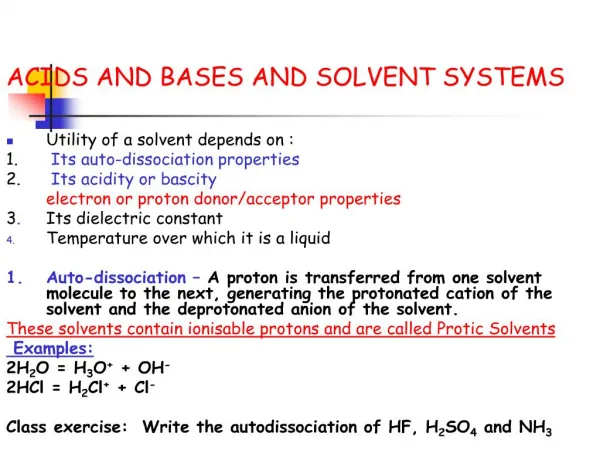
Acids & Bases Remember, if a formula starts with Hydrogen, that means it is an acid. And, if it ends with Hydroxide (-OH), that means it is a base.
So, what is an acid? What is a base? • An acid is anything that has the following properties: • tastes sour • pH less than 7 • reacts with metals • conducts electricity • neutralizes with a base • changes color of indicators
So, what is an acid? What is a base? • A base is anything that has the following properties: • tastes bitter • pH greater than 7 • feels slippery • conducts electricity • neutralizes with an acid • changes color of indicators
Let’s talk about the pH scale… The pH scale is a range of how acidic a compound is. pH1 = most acidic pH7 = neutral pH14 = least acidic (or, the most basic!) pH1 pH7 pH14
What do you think the pH is of… Orange juice pH= 3.3 acid Table salt pH= 7 neutral Coffee pH= 5 acid Ammonia pH= 11 base Saliva pH= 6.3 acid