Understanding Ionic and Covalent Bonds: A Guide to Transition Metals and Polyatomic Ions
This lesson covers the essential differences between ionic and covalent bonds, focusing on how ionic bonds form between positively and negatively charged ions while covalent bonds involve sharing electrons. Students will learn to write symbols and charges for common elements like potassium (K+), sodium (Na+), and nitrogen (N3-). Special attention will be given to transition metals, which have multiple stable charges, and polyatomic ions, important in both nature and biology. Through practice exercises, students will enhance their understanding of ionic compounds and the Stock system.

Understanding Ionic and Covalent Bonds: A Guide to Transition Metals and Polyatomic Ions
E N D
Presentation Transcript
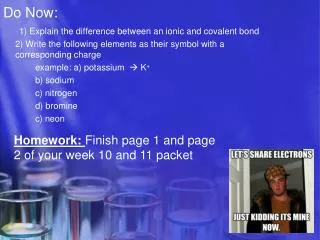
Do Now: 1) Explain the difference between an ionic and covalent bond 2) Write the following elements as their symbol with a corresponding charge example: a) potassium K+ b) sodium c) nitrogen d) bromine c) neon Homework: Finish page 1 and page 2 of your week 10 and 11 packet
Topic F - Bonding “Transition Metals and Common Polyatomic Ions”
Objective At the end of this lesson students will be able to: 1) Write the names and formulas for ionic compounds, including those requiring the stock system and those including polyatomic ions (3.5)
Purpose Transition Metals require special attention because they (all but 3) have multiple stable charges! Polyatomic ions are fairly common since they are so stable. They are found in nature and human biology quite frequently, but tend to give students a little trouble at first glance so they get special attention
What are the transition metals? Transition metals – The metals in the ‘d’ block on the periodic table have multiple stable ions. They are distinguished by an adjacent roman numeral. (stock system) Iron (II) – Fe2+ Iron (III) – Fe3+ Chromium (III) - Cr3+ Chromium (VI) - Cr6+ Copper (I) - Cu+ Copper (II) - Cu2+
Practice Write the symbol and charge of the most common ion for the following elements: Sodium Mercury (II) Iron (II) Copper (I) Nitrogen Lithium Barium Vanadium (V) Bromine
Exceptional Transitions Silver is always +1 Zinc is always +2 Cadmium is always +2 Ag+ Zn2+ Cd2+
Practice Write the symbol and charge for the following elements: Gold (II) Manganese (IV) Iron (III) Zinc Silver Arsenic
What is a Polyatomic Ion? Polyatomic ions – multiple atoms covalently bonded together that often form an ionic bond
Common Polyatomic Ions Hypochlorite ClO- Chlorite ClO2- Chlorate ClO3- Perchlorate ClO4- Permanganate MnO4- Bromate BrO3- Phosphate PO43- Sulfite SO32- Sulfate SO42- Nitrite NO2- Nitrate NO3-
Other Polyatomic Ions Ammonium NH4+ Mercury (I) Hg22+ Chromate CrO42- Dichromate Cr2O72- Cyanide CN- Thiocyanate SCN- Oxalate C2O42-
Practice What is the formula for the following polyatomic ions? Dichromate Sulfite Nitrate Oxalate Ammonium Bromate
Review At the end of this lesson students will be able to: 1) Write the names and formulas for ionic compounds, including those requiring the stock system and those including polyatomic ions (3.5)