Download
1 / 17
170 likes | 288 Vues
This report by Monika Kopacz delves into the sources and impacts of anthropogenic CO2 in oceans, highlighting major contributors like fossil fuel combustion, biomass burning, and land use changes. With approximately 7 Pg of CO2 emitted annually, the current oceanic carbon cycle is in a state of flux, emphasizing the need for concern. The study examines CO2 uptake mechanisms, trends in different ocean regions, and the biological processes at play. It concludes with proposed solutions for restoring balance, including pollution reduction and carbon sequestration.

E N D
Oceans and anthropogenic CO2 By Monika Kopacz EPS 131
(Atmospheric) sources of anthropogenic CO2 • Fossil fuels (oil, gas, coal) • Biomass burning (deforestation and others) • Farming • Land-use conversion • Production of cement Total about 7 Pg (1015 g) per year
Atmospheric concentration Figure adapted from Whitehouse Initiative on Global Climate Change
What do we want to learn? • Anthropogenic CO2 presence in the oceans: sources, sinks, fluxes • Changes that have occurred so far, are occurring right now and are anticipated in the future • Should we be concerned or will Mother Nature heal itself?
Box model of CO2 fluxes * Right now: not in steady state
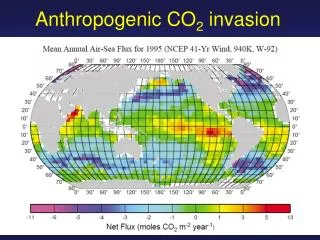
CO2 air-sea fluxes • Trends: • Equatorial Pacific: strong source of CO2 throughout the year • Subtropical oceans: upwelling and uptake depend on water temperature • High-latitude oceans: mostly deep water upwelling in the winter and biological uptake during spring and summer • Dependencies: Along with pressure differences, fluxes depend on gas transfer velocity (derived from other tracers), solubility (function of temperature and salinity)
Facts about CO2 uptake • CO2 is more than twice soluble in cold water than in warm water • Marine phytoplankton transforms CO2 to organic carbon (Vertical gradient of dissolved inorganic carbon: 20% due to solubility pump, 80% due to biological pump)
Calculating CO2 uptake • Using oceanic tracers such as carbon-14, tritium and chlorofluorocarbons (CFC’s) to: • directly measure fluxes into ocean and circulation within • simulate CO2 uptake and distribution with a model (based on previously measured quantities)
Separating anthropogenic CO2 from natural From: Gruber, N., 1998: “Anthropogenic CO2 in the Atlantic Ocean.” Global Biogeochem. Cycles
Anthro- pogenic CO2 distribution Gruber, N., 1998: “Anthropogenic CO2 in the Atlantic Ocean.” Global Biogeochem. Cycles And “Global CO2 survey”
Ocean as a sink for CO2: Solution to global warming? Limitations to ocean CO2 uptake: limited buffering capability
Climate implications • Increased level of CO2 in surface water 30% decrease in carbonate ion by mid-century reduction of coral reef * • More anthropogenic co2 Global warming warming of the oceans Slower circulation another ice age * "Effect of calcium carbonate saturation state on the calcification rate of an experimental coral reef“ by Takahashi
Ideas for restoring steady state • Sequestration • Collecting industrial CO2 and depositing it in deep ocean (>1000m), much like it is already being deposited in the earth
Conclusions: • Ocean carbon cycle is currently not in steady state • Future climate change • Most realistic solution: decrease pollution