Exploring Democratic Education: Insights from Dewey to Modern Instructional Practices
This week, the focus is on the principles of democratic education as influenced by John Dewey. Students will review key court cases regarding student rights and the limitations faced by educators and administrators. Discussions will revolve around providing equal educational opportunities and improving instructional practices. We'll examine Dewey's thoughts on the effectiveness of schools in equalizing opportunities, the challenges of individualism, and the evolution of educational theory over the past century, including critiques from various educational perspectives.

Exploring Democratic Education: Insights from Dewey to Modern Instructional Practices
E N D
Presentation Transcript
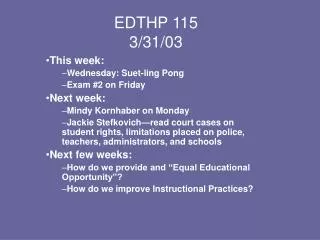
EDTHP 1153/31/03 This week: Wednesday: Suet-ling Pong Exam #2 on Friday Next week: Mindy Kornhaber on Monday Jackie Stefkovich—read court cases on student rights, limitations placed on police, teachers, administrators, and schools Next few weeks: How do we provide and “Equal Educational Opportunity”? How do we improve Instructional Practices?
Today: Democracy & Education • Images of Schools and Classrooms • Dewey, Democracy, and Schooling • What worked and what did not • The promise of the American common school—how to maintain that promise • Do schools equalize opportunity? From the common school to Coleman • The challenge of individualism • Other perspectives: Conservatism, Critical Theory, Revisionism, Critical Pedagogy
Images of Schools and Classrooms • Facilities • Classrooms • Organization • Health • Diversity • New Problems and Crises • What should students be taught, how should teachers teach, and how should students learn?
Dewey, Democracy, and Schooling • The questions (and some answers) for educators over the past 100 years: • How do we educate students large numbers of students? • Individualized education vs. mass education • Activity based learning • New Teaching Methods • Tracking
Dewey, Democracy, and Schooling(con’t.) • What should students learn and how do we prepare them for a changing society? • Some answers: • Differentiated curriculum • Vocational education • Guidance and counseling • Technology • Rigorous academic curriculum • Problem-based learning • Standards
Dewey, Democracy, and Schooling(con’t.) 3. How should teachers teach? • Follow curriculum established by local administrators • Create own curriculum • Follow curriculum set by the state
Dewey, Democracy, and Schooling(con’t.) What did Dewey mean when he talked about democracy and education? • Opposed to old approach—led to docility, receptivity, obedience, and to the imposition of adult standards. Learning was seen as static and lifeless. Preparation for a remote future. Old education could be mis-educative (pp. 18-19, 25).
Dewey (con’t.) 2. Democracy and true progressive education • Not “planless improvisation” (28) • Clear philosophy of education necessary (28) and education must delve into the roots of the past (29, 77) • Educators must find ways “for doing consciously and deliberately what ‘nature’ accomplishes in the earlier years” (74) • Problems are the stimulus to thinking. Educators must do two things: • That the problem grows out of current experience and that it is within the range of capacity of students • It arouses in the learner an active quest for information and for production of new ideas (79)
Dewey (con’t.) • No one course of study for all progressive schools (78) • However, subject-matter very important • This new approach viewed students as citizens—and teachers as professionals and intellectuals • “the road of the new education is not an easier one to follow than the old road but a more strenuous and difficult one” (90)
What worked and what didn’t • Dewey very hard to translate into practice • Administrative Progressives offered clear organizational charts, curriculum plans, tests, etc.