
Understanding Ecosystems: Components and Cycles
E N D
Presentation Transcript
Ecosystem Mr. Hake M. A. Deptof Botany
Contents • What is an ecosystem • Three major principles of ecosystem • Components of an ecosystem • Abiotic components • Biotic components • Movement of energy and nutrients • Food chain • Food webs • Trophic levels, biomass and biome • Linkages and interactions in an ecosystem • Carbon cycle and oxygen cycle • Model of nutrient cycle • Environmental Limitation in ecosystem development.
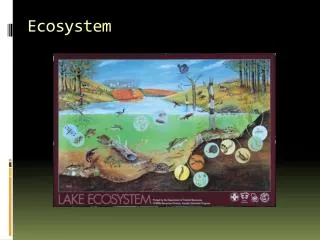
What is an ecosystem • An ecosystem is a grouping of organisms that interact with each other and their environment in such a way as to preserve the grouping. • There is a great variety of ecosystems in existence, all of them are characterized by general structural and functional attributes.
Three major principles of ecosystem • Nutrient cycling: • Movement of chemical elementsfrom the environment into living organisms and from them back into the environment through organisms live, grow, die and decompose. • Energy flow: • Energy is required to transform inorganic nutrients into organic tissues of an organism. • Energy is the driving force to the work of ecosystem. • Structure • It refers to the particular pattern of inter-relationships that exists between organisms in an ecosystem.
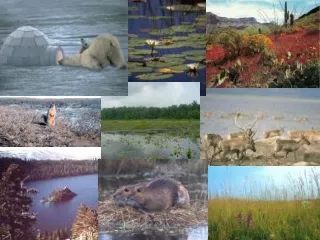
Abiotic components • They form the environment and determine the type / structure of ecosystem. • Sunlight (temperature) • Nutrients • Rainfall, minerals, carbon, nitrogen,….. • Type of ecosystems: • Tropical rainforest, Desert, Tundra, Grassland,…..
Biotic components • Producers (Autotrophs): • All green plants. They use solar energy, chlorophyll, inorganic nutrients and water to produce their own food. (Photosynthesis) • Consumers: • They consume the organic compounds in plant and animal tissues by eating. • Herbivores (plant feeders) Primary consumers • Carnivores (meat eaters) Secondary consumers • Omnivores (general feeders)
Biotic components • Decomposers • They are tiny organisms includes bacteria and fungi, which turn organic compounds in dead plants and animals into inorganic materials. • They cause the continual recirculation of chemicals within ecosystem (nutrient cycle)
Movement of energy and nutrients • Food chain • Food webs • Trophic level, biomass and biome
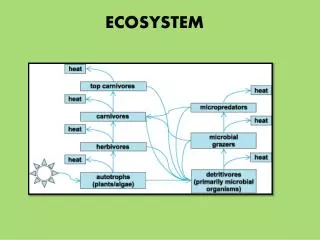
Food Chain • The particular pathway of nutrient and energy movement depends on which organism feeds on anther. Decomposers
Trophic Levels • A trophic level means a feeding level. • First level – all producers • Second level – all herbivores • Third level – first level carnivores • Fourth level – second level carnivores • So on……..
Trophic levels • Energy and Nutrients passed through the ecosystem by food chains and webs from lower trophic level to the higher trophic level. • However, only 5% to 20% energy and nutrients are transferred into higher trophic level successfully. • For this reason, first trophic level has the largest number of organisms, and second trophic level is less than first one; the third level is less than second level, and so on.
Biomass • Biomass means the total combined weight of any specified group of organisms. • The biomass of the first trophic level is the total weight of all the producers in a given area. • Biomass decreases at higher trophic levels.
Biome • This is a total different concept apart from Biomass. • Biome are defined as • “the world’s major communities, classified according to the predominant vegetation and characterized by adaptations of organism to that particular environment.
Linkages and Interactions in an ecosystem • Carbon and Oxygen cycle • Nitrogen cycle • A model of nutrient cycle
Nitrogen cycle • Nitrogen cycle can be affected by man in five major ways: • Fertilizer production (mainly nitrates and ammonium salts) to grow more food by increasing yields, and replenishing lost nitrogen from the soil. • Burning of fossil fuels in cars, power plants, and heating which puts nitrogen dioxide into the atmosphere. • Increasing animals wastes (nitrates) from more people and from livestock and poultry grown in ranches. • Increased sewage flows from industry and urbanization. • Increased erosion of and runoff nearby streams, lakes and rivers from cultivation, irrigation, agricultural wastes, mining, urbanization and poor land use.
Model of Nutrient Cycle • Nutrients (chemicals, minerals or elements) are circulated around the ecosystem and recycled continually. • Gersmehl identified three storage compartments. • Litter: the surface layer of vegetation which may eventually become humus. • Biomass: the total mass of living organisms, per unit area. • Soil: the nutrients store in soil (weathered material) and semi-weathered material.
Environmental Limitation in ecosystem development • Principles of limiting factors • Law of the maximum • Law of the minimum • Principle of holocoenotic environment • Limiting factors of an environment • Light • Temperature • Water • Wind • Topography • Soil • Biotic factors
Principle of holocoenotic environment • A German ecologist Karl Friederich (1927) suggested that 'community-environmental relationship are holocoenotic'. This means that there are no 'walls' or barriers between the factors of an environment and the organism or biotic community. • If one factor is changed, almost all will change eventually. • Example: Temperature Air can hold more water Evaporation rates Relative Humidity Dryness of soil Transpiration Free water in soil Plants absorb soil water
Limiting factors of an environment • Light • Temperature • Water • Wind • Topography • Soil • Biotic Factors
Light • Light is an very important environment factor: • Source of energy for ecosystem • Control factor for reproduction and migration.
Light • Quality of light: • Red and blue light: green plants (photosynthesis) • Green light: plants in woods or deep water • Ultraviolet light: retards plant growth • Duration of light • Affect the behaviour of plants and animals (flowering, migration, mating….) • Intensity of light: • Controlling factor for rate of photosynthesis • Net productivity is the function of photosynthesis and respiration.
Temperature • Very important factor affecting • Directly effects on organisms • Indirectly effects in modifying other environmental factors such as relative humidity and water availability. • Each species has its own minimum, maximum and optimum temperatures for life. (vary with age and water balances in the body) • Aquatic life has narrower tolerance ranges for temperature than those which live on land. • Tropical plants: > 15oC, • Temperate cereals: >-2oC, • Coniferous forests: withstand many degrees below freezing.
Water • Water restrict ecosystem development because ,most organisms need large amounts of water to survive. • Water requirement for plants will vary both with environmental conditions and among different species. • Actual rate of transpiration is the function of • relative humidity • Air movement • Size of leaves • Size of stomata
Water • Plants classification by water requirement. • Xerophytes: plants can survive in extremely arid areas. • Halophytes: plants can survive in saline conditions • Hydrophytes: plants live in water or in moist soil.
Wind • Wind can act as an environmental factor • Directly by causing mechanical damage to plants • Indirectly affecting relative humidity and evaporation rates. • High wind speed increases the rate of transpiration. • Mountain summits, coasts and open plains vegetation may be dwarfed as a result of wind action.