
SlideServe
Menu
Préférences
© SlideServe · v2026

Impact of CYP2D6 and UGT2B7 Genotypes on Tamoxifen and Anastrozole Efficacy in Recurrence Risk

wyatt avatar
12 diapositives · 271 Views · Aug 13, 2014

This study investigates the role of CYP2D6 and UGT2B7 genotypes on the recurrence risk in breast cancer patients treated with tamoxifen and anastrozole, analyzed through the ATAC trial data. Recurrence probabilities were assessed using Cox proportional hazard models, highlighting differences in distant and any recurrence rates based on genetic variations. The analysis presents a comprehensive view of how genotyping can inform treatment efficacy and recurrence outcomes in hormone receptor-positive breast cancer patients.
Impact of CYP2D6 and UGT2B7 Genotypes on Tamoxifen and Anastrozole Efficacy in Recurrence Risk - slide 1
01 / 12Impact of CYP2D6 and UGT2B7 Genotypes on Tamoxifen and Anastrozole Efficacy in Recurrence Risk
1 / 17

Télécharger la présentation

Impact of CYP2D6 and UGT2B7 Genotypes on Tamoxifen and Anastrozole Efficacy in Recurrence Risk
Une image / un lien ci-dessous est fourni (tel quel) pour télécharger la présentation

Politique de téléchargement : le contenu du site vous est fourni TEL QUEL pour votre information et votre usage personnel ; il ne peut être vendu, concédé sous licence ni partagé sur d’autres sites sans l’accord de son auteur.Le contenu vous est fourni TEL QUEL, pour votre information et votre usage personnel uniquement. Téléchargez la présentation en cliquant sur ce lien. Lors du téléchargement, si vous ne parvenez pas à télécharger une présentation, l’éditeur a peut-être supprimé le fichier de son serveur.Pendant le téléchargement, si vous ne parvenez pas à obtenir une présentation, le fichier a peut-être été supprimé par l’éditeur.

F I N

Plus de contenu associé

Transcription de la présentation
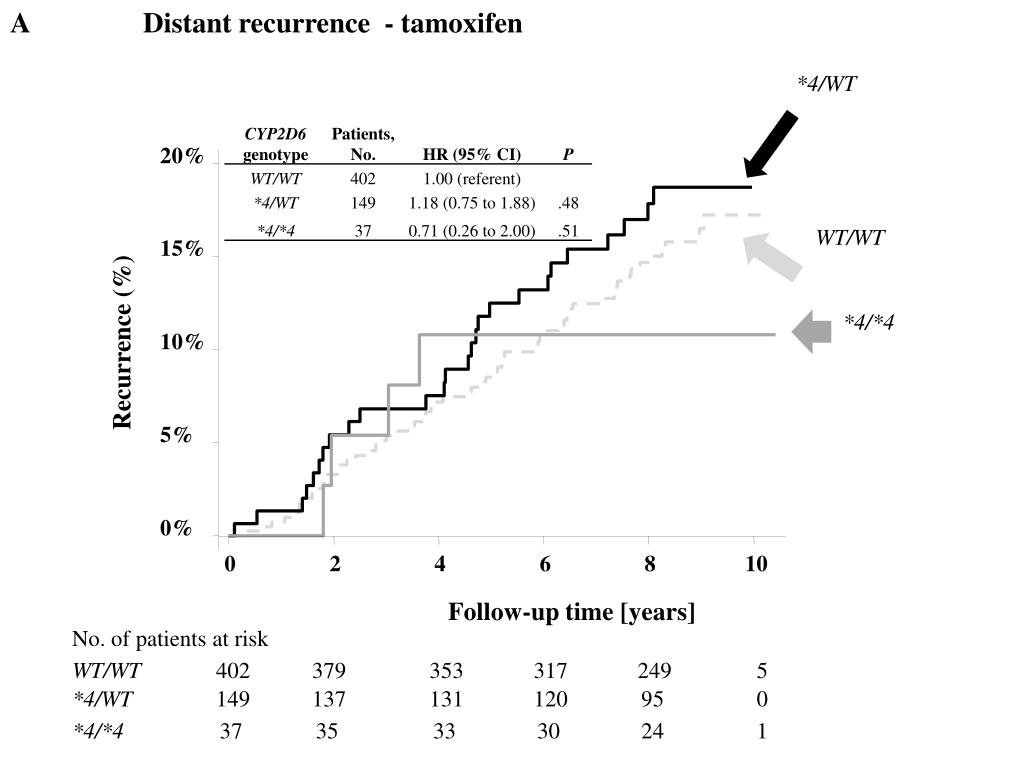
  1. A Distant recurrence - tamoxifen *4/WT 20% WT/WT 15% *4/*4 Recurrence (%) 10% 5% 0% 0 2 4 6 8 10 Follow-up time [years] • No. of patients at risk WT/WT 402 379 353 317 249 5 *4/WT 149 137 131 120 95 0 *4/*4 37 35 33 30 24 1

  2. B Any recurrence - tamoxifen *4/WT 30% WT/WT 20% Recurrence (%) *4/*4 10% 0% 0 2 4 6 8 10 Follow-up time [years] • No. of patients at risk WT/WT 402 376 347 307 238 4 *4/WT 149 135 127 114 90 0 *4/*4 37 35 33 29 21 0

  3. Supplementary Figure 1. Probability of recurrence in patients enrolled in the ATAC trial according to CYP2D6*4 genotype. Recurrence was assessed in patients who were randomly assigned to the tamoxifen group using a Cox proportional hazard model. Homozygous wild-type CYP2D6, ie,CYP2D6*1/*1, is shown as WT/WT,heterozygous CYP2D6*4, ie, CYP2D6*4/WT is shown as *4/WT, and homozygous CYP2D6*4, ie, CYP2D6*4/*4 is shown as *4/*4. Two-sided P values were calculated using an adjusted Cox proportional hazard model. A) Distant recurrence. B) Any recurrence. HR = hazard ratio; CI = confidence interval.

  4. A Distant recurrence - tamoxifen *2/*2 20% *2/WT 15% WT/WT Recurrence (%) 10% 5% 0% 0 2 4 6 8 10 Follow-up time [years] • No. of patients at risk 121 114 109 96 73 0 WT/WT *2/WT 274 257 238 218 177 3 *2/*2 174 162 153 136 102 3

  5. B Any recurrence - tamoxifen *2/WT *2/*2 20% Recurrence (%) 10% WT/WT 0% 0 2 4 6 8 10 Follow-up time [years] • No. of patients at risk WT/WT 121 114 108 94 72 0 *2/WT 274 255 231 206 163 1 *2/*2 174 159 151 133 98 3

  6. Supplementary Figure 2. Probability of recurrence in patients enrolled in the ATAC trial according to UGT2B7*2genotype. Recurrence was assessed in patients who were randomly assigned to the tamoxifen group using a Cox proportional hazard model. Homozygous wild-type UGT2B7, ie, UGT2B7*1/*1 is shown as WT/WT, heterozygous UGT2B7*2, ie, UGT2B7*2/WT is shown as *2/WT, and homozygous UGT2B7*2, ie, UGT2B7*2/*2 is shown as *2/*2. Two-sided P values were calculated using an adjusted Cox proportional hazard model. A) Distant recurrence. B) Any recurrence. HR = hazard ratio; CI = confidence interval.

  7. A Distant recurrence - anastrozole EM (2) 20% 15% IM (1) 10% IM (0.5) Recurrence (%) PM (0) 5% IM (1.5) 0% 0 2 4 6 8 10 Follow-up time [years] • No. of patients at risk PM (0) 41 41 39 35 27 0 IM (0.5) 21 20 19 17 16 0 IM (1) 146 138 130 117 98 5 IM (1.5) 45 44 43 41 32 0 EM (2) 362 346 328 302 242 2

  8. B Any recurrence - anastrozole EM (2) IM (0.5) 20% IM (1) Recurrence (%) IM (1.5) 10% PM (0) 0% 0 2 4 6 8 10 Follow-up time [years] • No. of patients at risk PM (0) 41 40 38 34 26 0 IM (0.5) 21 20 19 16 15 0 IM (1) 146 138 130 116 97 5 IM (1.5) 45 44 43 41 31 0 EM (2) 362 345 323 297 234 2

  9. Supplementary Figure 3. Probability of recurrence in patients enrolled in the ATAC trial according to CYP2D6 phenotype. Recurrence was assessed in patients who were randomly assigned to the anastrozole group using a Cox proportional hazard model. A CYP2D6 activity score was assigned to each patient, which most accurately predict a patient’s CYP2D6 metabolic phenotype based on their genotype (31). The phenotypic scores are indicated in parentheses. Two-sided P values were calculated using an adjusted Cox proportional hazard model. A) Distant recurrence. B) Any recurrence. HR = hazard ratio; CI = confidence interval; PM = poor metabolizer, IM = intermediate metabolizer, EM = extensive metabolizer.

  10. A Distant recurrence - anastrozole WT/WT 20% 15% *2/*2 Recurrence (%) 10% *2/WT 5% 0% 0 2 4 6 8 10 Follow-up time [years] • No. of patients at risk WT/WT 121 116 110 97 71 2 *2/WT 293 280 265 245 210 4 *2/*2 173 167 159 147 113 1

  11. B Any recurrence - anastrozole WT/WT 20% 15% *2/WT 10% Recurrence (%) 5% *2/*2 0% 0 2 4 6 8 10 Follow-up time [years] • No. of patients at risk WT/WT 121 116 110 97 70 2 *2/WT 293 278 261 240 203 4 *2/*2 173 167 157 144 110 1

  12. Supplementary Figure 4. Probability of recurrence in patients enrolled in the ATAC trial according to UGT2B7*2 genotype. Recurrence was assessed in patients who were randomly assigned to the anastrozole group using a Cox proportional hazard model. Homozygous wild-type UGT2B7, ie, UGT2B7*1/*1 is shown as WT/WT, heterozygous UGT2B7*2, ie, UGT2B7*2/WT is shown as *2/WT, and homozygous UGT2B7*2, ie, UGT2B7*2/*2 is shown as *2/*2. Two-sided P values were calculated using an adjusted Cox proportional hazard model. A) Distant recurrence. B) Any recurrence. HR = hazard ratio; CI = confidence interval.