Download
1 / 8
80 likes | 233 Vues
In my research, I chose hydroelectricity as it stands out as a leading alternative energy source with minimal environmental impact. With almost no waste and little greenhouse gas emissions, hydropower plants worldwide generate a staggering 675,000 megawatts of energy. Although constructing a dam or a small hydropower plant can be expensive and pose risks like flash floods, the pros—such as renewable energy, flood control, and recreational opportunities—often outweigh the cons. An efficient source for communities like Tonopah promises both ecological and economic benefits.

E N D
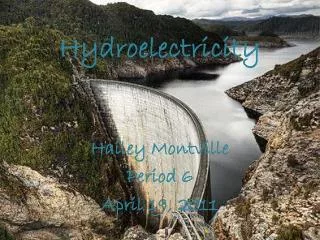
Hydroelectricity Hailey Montville Period 6 April 19, 2011
Why I chose it… • I chose to use hydroelectricity because it is the most common form of alternative energy, and also has almost no negative affect on the environment • It produces no direct waste and little greenhouse gas • The world's hydropower plants release a combined total of 675,000 megawatts, the energy equivalent of 3.6 billion barrels of oil • Because Tonopah is a little community, only a small plant would be built, contributing almost no waste to the environment
Building materials • A dam or hydropower plant would have to be built • Alternative ways to build these could be, underground plants or Run-of-the-river hydroelectric stations • Both of these run underground and require reservoirs
Pro’s • The dams can store rain water • Controls flooding and the lakes can provide a place for recreational activities • Its renewable and inexpensive • If needed, they can be shut down quickly • Very few breakdowns • Doesn’t harm the environment • If this was our main source for the school, we would save money and it wouldn’t harm us
Con’s • Dams can be expensive to build • If it breaks it can cause a massive flash flood • The plant decay caused downstream of dams can cause greenhouse gases • Droughts can cause a dam to be useless or produce less energy than planned • If this was the main source of energy for the school, there could be many breakdowns causing us to have little electricity
Bibliography • http://drake.marin.k12.ca.us/stuwork/rockwater/Upload%20this%20doc--dams%20and%20hydropower%20report/pros%20and%20cons.html • http://en.wikipedia.org/wiki/Hydroelectricity