Atomic Structure
This overview introduces the fundamental concepts of atomic structure, explaining what an atom is and its significance in matter. Atoms consist of two main regions: the nucleus, which houses protons and neutrons, and the electron cloud that surrounds it. The balance between protons and electrons determines an atom's neutrality. Explore subatomic particles, their interactions, and key concepts like atomic number, mass number, and isotopes. Gain insight into energy levels and valence electrons, essential for understanding chemical reactions.

Atomic Structure
E N D
Presentation Transcript
Atomic Structure Physical Science October 3, 2011
What is an atom? • Atom: the smallest unit of matter that retains the identity of the substance • First proposed by Democratus
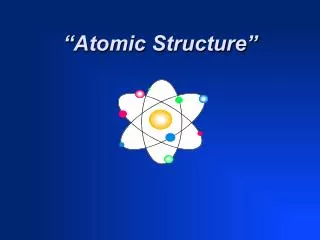
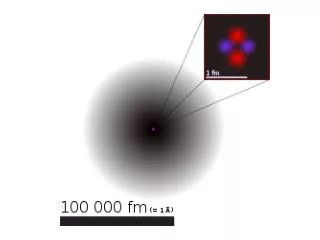
Atomic Structure • Atoms are composed of 2 regions: • Nucleus: the center of the atom that contains the mass of the atom • Electron cloud: region that surrounds the nucleus that contains most of the space in the atom Nucleus Electron Cloud
What’s in the Nucleus? • The nucleus contains 2 of the 3 subatomic particles: • Protons: positively charged subatomic particles • Neutrons: neutrally charged subatomic particles
What’s in the Electron Cloud? • The 3rd subatomic particle resides outside of the nucleus in the electron cloud • Electron: the subatomic particle with a negative charge and relatively no mass
Energy Level • Specific amount of energy an electron has.
Valence Electrons • The electrons that are in the highest energy level of an atom and that are involved in chemical reactions.
Isotopes • An atom with the same number of protons and a different number of neutrons from other atoms of the same element.
How do these particles interact? • Protons and neutrons live compacted in the tiny positively charged nucleus accounting for most of the mass of the atom • The negatively charged electrons are small and have a relatively small mass but occupy a large volume of space outside the nucleus
How do the subatomic particles balance each other? • In an atom: • The protons = the electrons • If 20 protons are present in an atom then 20 electrons are there to balance the overall charge of the atom—atoms are neutral • The neutrons have no charge; therefore they do not have to equal the number of protons or electrons
How do we know the number of subatomic particles in an atom? • Atomic number: this number indicates the number of protons in an atom • Ex: Hydrogen’s atomic number is 1 • So hydrogen has 1 proton • Ex: Carbon’s atomic number is 6 • So carbon has 6 protons **The number of protons identifies the atom. Ex. 2 protons = He, 29 protons = Cu
How do we know the number of subatomic particles in an atom? • Mass number: the number of protons and neutrons in the nucleus • Ex: hydrogen can have a mass of 3. Since it has 1 proton it must have 2 neutrons • # of neutrons = mass # - atomic #
Determining the number of protons and neutrons • Li has a mass number of 7 and an atomic number of 3 • Protons = 3 (same as atomic #) • Neutrons= 7-3 = 4 (mass # - atomic #) • Ne has a mass number of 20 and an atomic number of 10 • Protons = 10 • Neutrons = 20 - 10= 10
What about the electrons? • The electrons are equal to the number of protons • So e- = p = atomic # • Ex: He has a mass # of 4 and an atomic # of 2 • p+ = 2 • no = 2 • e- =2
Determine the number of subatomic particles in the following: • Cl has a mass # of 35 and an atomic # of 17 • p+ = 17, no = 18, e- = 17 • K has a mass # of 39 and an atomic # of 19 • P+ = 19, no = 20 e- = 19
How exactly are the particles arranged? • Bohr Model of the atom: Reviewers think this could lead to misconceptions! All of the protons and the neutrons The 3rd ring can hold up to 18 e- The 1st ring can hold up to 2 e- The 4th ring and any after can hold up to 32 e- The 2nd ring can hold up to 8 e-
What does carbon look like? Mass # = 12 atomic # = 6 p+ = 6 no = 6 e- = 6 6 p and 6 n live in the nucleus