Understanding the Urinary System: Structure, Disorders, and Essential Medical Terminology
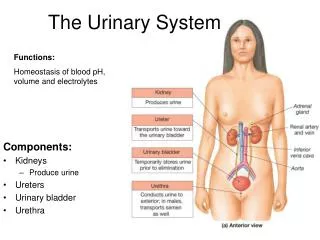
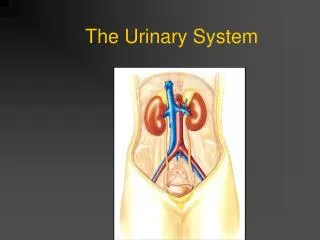
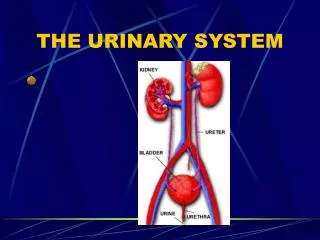
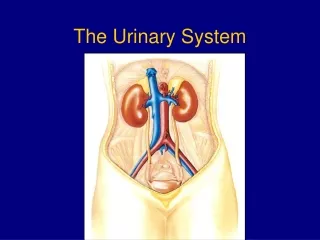
This chapter provides an in-depth overview of the urinary system, including a labeled diagram and the flow of urine through the body. Key objectives include identifying and describing the structure of the kidneys, analyzing major disorders related to the urinary system, and understanding crucial medical terminology. Important concepts such as urology, renal conditions, nephrology, urinalysis, and procedures like dialysis and nephrectomy are discussed to equip you with the knowledge needed for effective study and practice in this essential area of medicine.

Understanding the Urinary System: Structure, Disorders, and Essential Medical Terminology
E N D
Presentation Transcript
THE URINARY SYSTEM MEDICAL TERMINOLOGY T. sanaaAbdelhamed
OBJECTIVES At the end of this chapter you should be able to: 1.Lablel a diagram of the urinary system and follow the flow of urine through the body. 2. label a diagram of the kidney. 3.Describe the major disorders of the urinary system. 4.Analyze several case studies pertaining to urinary disorders. 5. Define medical terms commonly used in reference to the urinary tract.
MEDICAL TERMS RELATED TO THE URINARY SYSTEM Urinary (adj) means referring to the urine or to the urinary system. The combining form ur/o means urine or urinary system. Urology (n) study of the urinary system and its diseases.
3. Urography (n) means an X-ray examination of part of the urinary system after injection of radio-opaque dye.
4. Urine (n) a yellowish liquid containing water and waste products, which excreted by the kidney. The combining form is ur/o. urination – noun urinate – verb urinary - adj
6. Renal (adj) pertaining to the kidney. The combining form is ren/o means kidney7. Nephritis (n) inflammation of one or both kidneys. The combining form is nephr/o means kidney.
8. Nephrology (n) the study of kidney diseases.9. Nephrologist (n) doctor who specializes in urinary system disorders.10. Nephrosis (n) means any kidney disease. The suffix – osismeans abnormal condition.
12. Oliguria(n) means production of an abnormally small volume of urine. The prefix oligo- means few or little. The opposite is polyuria (much urination)13. Dysuria (n) means difficult or painful urination. The prefix dys- means difficult.
14. Urethra(n) a tube which takes urine from the bladder to be passed out of the body. The combining form is urethr/o.
15. Ureter (n) one of two tubes which take urine from the kidneys to the urinary bladder. The combining form is ureter/o.uretric – adj.
16. Ureterostomy (n) the surgical creation of an external opening into the ureter. The suffix –stomymeans create an opening.
17. Retention (n) means an inability to pass urine. 18. Dialysis (n) artificial filtration of waste products from blood.
19. Colic (n) means severe recurrent abdominal pain.20. Incontinence (n) means an inability to control excretory functions (urine or faeces).
21. Cystoscopy (n) visual examination of the bladder. Cyst/o is the combining form which means bladder.
22. Lithotripsy (n) means destruction of ureteric stone. The prefix litho- means stone. The suffix –tripsy means to destroy or crush.Lithotriptic – adj.Lithotriptor – instrument.
23. Pyeloplasty (n) surgical repair of the renal pelvis. The combining form pyel/o means renal pelvis.
24. Pyelotomy(n) means surgical incision into renal pelvis. The suffix –tomymeans incision.