Effective Communication Media for Engineers: Choosing the Right Tools
100 likes | 231 Vues
In today's fast-paced engineering environment, selecting the appropriate communication media is crucial. This guide explores various options, including phone calls, emails, memos, and instant messaging. It outlines essential criteria for media selection, such as recipient preferences, security concerns, and the intended message's importance. Furthermore, it provides practical tips for writing business correspondence, dealing with tricky situations, and utilizing various email functions effectively. Enhance your professional communication to ensure clarity and effectiveness in your engineering practice.


Effective Communication Media for Engineers: Choosing the Right Tools
E N D
Presentation Transcript
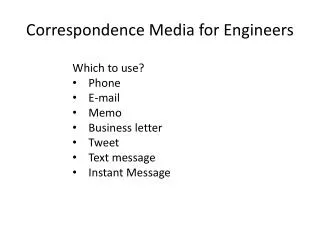
Correspondence Media for Engineers • Which to use? • Phone • E-mail • Memo • Business letter • Tweet • Text message • Instant Message
Criteria for Media Selection • Recipients’ preferences • Reply or forwarding requirements • Security concerns • Importance or length of the communication • In-your-face factor
Business Correspondence Style • Indicate the topic and purpose in the first sentence. • Identify the context of the communication. • Provide an overview of the communication. • Keep paragraphs short. • Use headings in longer communications. • Use bulleted and numbered lists for readability. • Use a brief, succinct writing style. • Use the “you” writing style. • Indicate action expected of the recipient.
Tricky Situations • Tell the boss “no.” • Tell a client “no.” • Admit a mistake. • Assert that you did not make the mistake. • Point out a mistake. • Persuade a client or colleague. • Communicate bad news. • Request reimbursement. • Issue an unpleasant directive.
Business Letter Format Date Heading (sender’s address) Inside address (recipient) Salutation (punctuated with a colon) Body (multiple paragraphs) Complimentary close Signature block
Memo Format DATE: TO: FROM: SUBJECT: (Body: multiple paragraphs)
Important E-Mail Functions • Save e-mail to meaningfully named folders. • Keep copies of e-mail sent. • Be able to search e-mail. • Create and use distribution lists. • Create and use a signature. • Use templates. • Proofread e-mail carefully (watch for missing words!). • Plan for e-mail access while on the road.
E-Mail Style • Use caution with informal style. • Seek brevity even more than in business letters. • Compose specific, motivating subject lines. • State context early—assume recipient amnesia. • State important information first. • Keep paragraphs short. • Proofread carefully—watch for missing words! • Use headings, lists, highlighting if they increase readability. • Be careful with automatic replies.
Internet Media • Forums • Blogs • Online meeting applications • Social media: • Websites (e.g., Facebook, LinkedIn) • Microblogs (e.g., Twitter) • Google: • Docs • Drive • Circles