
SlideServe
Menu
Préférences
© SlideServe · v2026

NS.7.c Exploring Integers & the Number Line Positive Integers Negative Integers Opposites

xiang avatar
11 diapositives · 386 Views · Jul 25, 2014

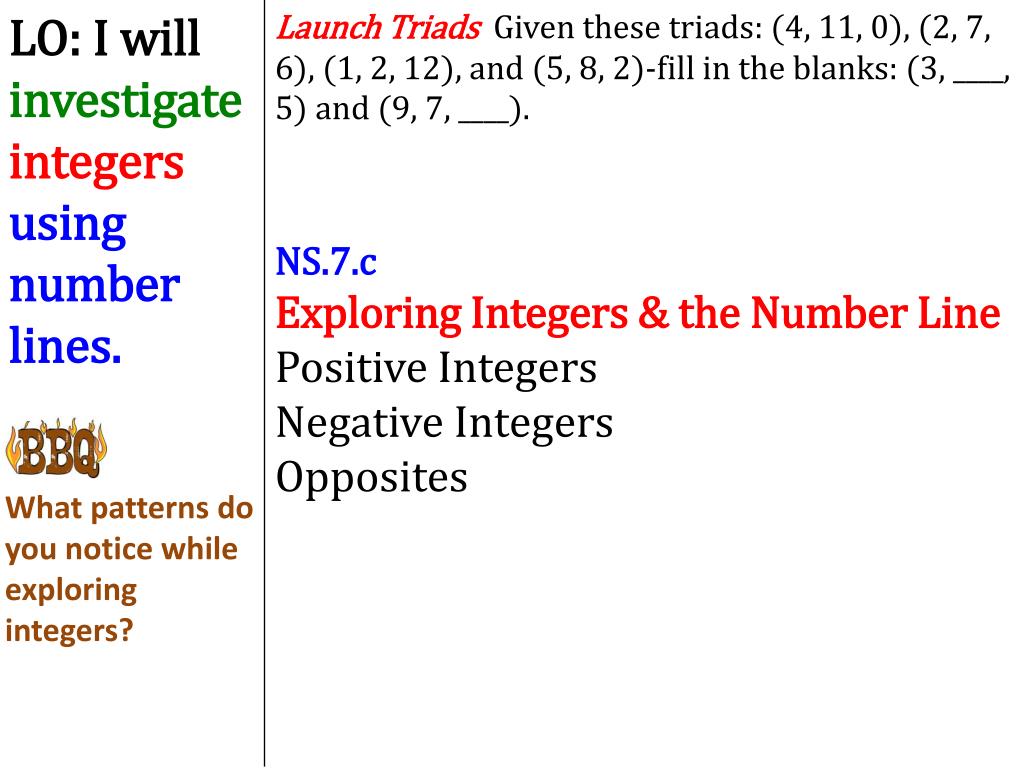
L O : I will investigate integers using number lines. Launch Triads Given these triads: (4 , 11, 0), (2, 7, 6), (1, 2, 12), and (5, 8, 2 )-fill in the blanks: (3, ____, 5) and (9, 7, ____). NS.7.c Exploring Integers & the Number Line Positive Integers Negative Integers Opposites.
NS.7.c Exploring Integers & the Number Line Positive Integers Negative Integers Opposites - slide 1
01 / 11NS.7.c Exploring Integers & the Number Line Positive Integers Negative Integers Opposites
1 / 17

Télécharger la présentation

NS.7.c Exploring Integers & the Number Line Positive Integers Negative Integers Opposites
Une image / un lien ci-dessous est fourni (tel quel) pour télécharger la présentation

Politique de téléchargement : le contenu du site vous est fourni TEL QUEL pour votre information et votre usage personnel ; il ne peut être vendu, concédé sous licence ni partagé sur d’autres sites sans l’accord de son auteur.Le contenu vous est fourni TEL QUEL, pour votre information et votre usage personnel uniquement. Téléchargez la présentation en cliquant sur ce lien. Lors du téléchargement, si vous ne parvenez pas à télécharger une présentation, l’éditeur a peut-être supprimé le fichier de son serveur.Pendant le téléchargement, si vous ne parvenez pas à obtenir une présentation, le fichier a peut-être été supprimé par l’éditeur.

F I N

Plus de contenu associé

Transcription de la présentation
  1. LO: I will investigateintegers using number lines. Launch Triads Given these triads: (4, 11, 0), (2, 7, 6), (1, 2, 12), and (5, 8, 2)-fill in the blanks: (3, ____, 5) and (9, 7, ____). NS.7.c Exploring Integers & the Number Line Positive Integers Negative Integers Opposites What patterns do you notice while exploring integers?

  2. Temperature Changes London +13°C Beijing −5°C Paris +22°C Vancouver −11°C

  3. Instructions for Working Together • Take turns to place cards. • When it is your turn, connect two City Temperature cards using a Changes in Temperature arrow card. • Figure out any missing temperatures. • Explain your calculations. • If others in your group disagree, they should explain why. Then figure out the answer together. • When you have reached an agreement, write your solution in the box on the card.

  4. More Temperature Changes London +8°C +7°C Madrid _ _ _ _ _ _ _ _ _ _ _ Berlin _ _ _ _ _ _ _ _ _ _ _ −12°C Tromso −7°C Tromso −7°C London +8°C _ _ _ _ _ _ _ _ _ _ _ _ _ _ _ _ _ _ _ _

  5. Use <, >, or = to compare the scores. • Aaron’s score is 4, Julie’s score is –1. • Fran’s score is –2, and Yin's score is –3. • List the golf scores in order from the Lowest to the Highest, –4, 2, 5, and –3. • List the integers in order from the Least to the gReatest. The scores are –3, 1, 0, and –2.

  6. (Problem Solving in Mathematics, Lane County Mathematics Project, 1991) Numbers are missing from the Celsius thermometer pictured at the right. The marks are in 5° intervals. Use the thermometer to complete the following exercises. Arrange these temperature readings from coldest to warmest: -10°, 15°, -3°, 0°, 21°, -2° 2. Suppose the present temperature is 5°. What is the reading if the temperature rises 20°? b. rises 5°? c. falls 17°? 3. Suppose the present temperature is -5°. What is the reading if the temperature rises 30°? b. rises 5°? c. falls 14°? 4. What temperature reading would be halfway between a. 0° and 40°? b. -15° and 5°? c. 2° and -10°? d. -10° and 10°? e. 15° and -5°? f. 5° and -13°?

  7. 5. Which temperature is farther from -2°? a. 7° or -10° b. 2° or -8° c. 1° and -5° 6. M, N, P, and Q represent four different temperature readings. Draw a thermometer and locate the points to fit the clues. Q is the coldest. P is positive. P is closer to Q than to N. M and Q are the same distance from zero.

  8. Real-life Connections Negative Integers Positive Integers How do integers affect your life on a daily basis?

  9. What do you notice about the mid-point of opposites?