A Canticle for Leibowitz: Exploring Humanity’s Hope After Nuclear Catastrophe
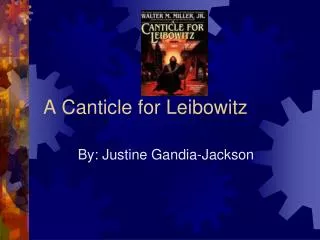
"A Canticle for Leibowitz" is a thought-provoking novel set in a post-apocalyptic America, exploring humanity's struggle to preserve knowledge after a nuclear disaster. Written in 1959, the story unfolds in three sections: "Fiat Homo," "Fiat Lux," and "Fiat Voluntas Tua," showcasing themes of cultural decay, the futility of present endeavors, and the breakdown of communication. The Catholic Church plays a pivotal role in safeguarding ancient wisdom, yet its guardians often fail to understand the significance of what they preserve. This novel prompts readers to reflect on hope, the pace of scientific progress, and humanity's lessons from history.

A Canticle for Leibowitz: Exploring Humanity’s Hope After Nuclear Catastrophe
E N D
Presentation Transcript
A Canticle for Leibowitz Life after nuclear war can be an exciting adventure
The Setting • America following a nuclear war • At that time, science fiction writers would refer to this kind of setting as “post-holocaust” • Pre-war knowledge is gathered and preserved by the Catholic church
The three sections • Fiat Homo = “Let there be man” • Fiat Lux = “Let there be light” • Fiat Voluntas Tua = “Thy Will Be Done”
Context for Leibowitz • Written at a time when there was a concern over nuclear war (1959) • Setting is a post-nuclear world • Knowledge is preserved, but not fully understood
Key Themes • Things that once were culturally relevant are now archaic, ceremonial and no longer fully understood by everyone • Examples: Latin references, the shopping list, etc. • Book becomes its own metaphor
Key Themes • In a post-apocalyptic world, communication breaks down • Communities live in isolation • People live without understanding technology
Futility of the present • People spend time doing jobs they do not understand • Fear that humanity may not have learned the lessons of the past • Does humankind have the ability to survive the worst?
Religion • After the decline of the Roman Empire, monks kept knowledge alive • Novel plays upon that idea, with main characters who are custodians of manuscripts • But the characters do not understand much of what they preserve
Brother Frances • His character is based on the life of a monk in Medieval times • Updated to reflect post-apocalyptic world • Science is in its infancy in his world
An ancient “artifact” (p. 26) • “He handled the papers as he might handle holy things” • A shopping list • “Pound pastrami, can kraut, six bagels – bring home for Emma.”
Summary • As you read “Canticle” think about whether or not the novel allows for hope for humanity • Also consider the rate of progess. How far does science advance? • What role does history play in this work?