Download
1 / 8
80 likes | 196 Vues
This article explores the application of STELLA as a powerful simulation tool in chemical education. It emphasizes the creation of scenarios to facilitate inductive thinking, allowing students to understand variable interrelations and their effects on various chemical phenomena. The simulations cover acid-base titration, chemical kinetics, and more, promoting active learning environments and improving students' experimental design skills. Leveraging time-efficient and cost-effective simulations helps avoid real experimental noise, making them invaluable for modern chemistry education.

E N D
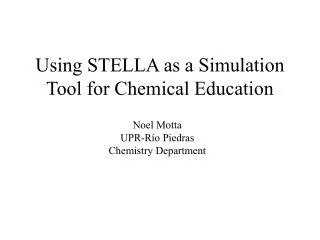
Using STELLA as a Simulation Tool for Chemical Education Noel MottaUPR-Río PiedrasChemistry Department
STELLA Application Scenarios P(t, X(t), Y, Z, …) P t ó X(t) LEVERAGE !!!!! Data on P is available, but do not know how X, Y, Z affect it. Data on P is not available, nor do not know how X, Y, Z affect it. Data on P is available, and know how X, Y, Z affect it.
CNaOH = 0.100 M pH vs VNaOH 2.345 VHA = 50.00 mL HAac CHA = 0.0500 M pKHA = 5.00 NaOH + HA H2O + A- + Na+ HA + H2O H3O+ + A- 2 H2OH3O+ + OH- Ka Kw
Simulations developed or being developed by author Acid-Base Titration Chemical Kinetics Chemical Equilibrium Chromatography (on the way) Cyclic Voltammetry (on the way) Density Flow Injection Analysis Heat transfer Kinetic vs Thermodynamic control in organic reactions (on the way) Stoichiometry
Simulations…… Allow the creation of situations for inductive thinking processes to take place. Promote the process of identifying variables and its interrelations, and the observation of their effect on the phenomenon or properties under study. Reinforce the idea of using the experiment to acquire new knowledge. Can be used to develop experimental design skills.
With simulations…… Get results that are time/cost effective. Avoid real experimental noise. Create active learning environments.
Implementation Strategies Conceptual Framework Simulation Concentric Model Excentric Model Simulation Conceptual Framework
Acknowledgements Javier Figueroa AMP Joaquín Medín