Exploring the Nature of Images: Production, Perception, and Research Methodologies
170 likes | 284 Vues
This insightful exploration delves into the essence of images, addressing fundamental questions about their meaning and context. It investigates how images are produced, emphasizing their social, cultural, and political dimensions. By examining the processes of viewing and interpreting images, the work challenges readers to consider manipulation, generalization potentials, and the superficiality of appearances. Additionally, it offers guidance on creating images for research, advocating for a systematic approach to enhance understanding and representation in academic contexts.


Exploring the Nature of Images: Production, Perception, and Research Methodologies
E N D
Presentation Transcript
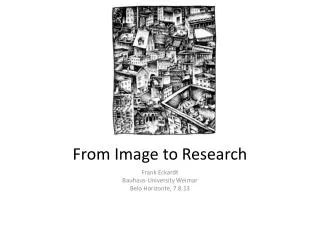
From Image to Research Frank Eckardt Bauhaus-University Weimar Belo Horizonte, 7.8.13
Content • What is an image? • How is an imageproduced? • How to view images? • How tomakeimagesforresearch?
1. What is an image? Actofcommunication Symbolicalexchange Presumedreceivers
1. What is an image? Selectiveperception Representingexperience Reflectingsocialfilters
1. What is an image? Attemptstocontrollthefuture Proposingnovities (or) reproducingexisting narratives
2. How is an image produced? Socialcontextualisation: Insider definitions Invisibilityofoutsiders Legitimation ofexclusion
2. How is an image produced? Cultural contextualisation: Representingnormality Proposingrolerelations Symbolizingvalues
2. How is an image produced? Political contextualisation: Reflecting power relations Prescribingexpectations Legitimizinginstitutions
3. How to view images? • Manipulation?
3. How to view images? 2. Generalisation opportunities?
3. How to view images? 3. Onlyfacade?
3. How to view images? 4. Contrastingknowledge?
4. How to make images for research? • Systematizingexistingimages
4. How to make images for research? 2. Whatisunknown?
4. How to make images for research? 3. Howtodevelop a SYSTEMATIC APPROACH?
4. How to make images for research? 4. Form ofinterpretationandrepresentation
4. How to make images for research? 5. Extra valueofimages