Download
1 / 13
130 likes | 269 Vues
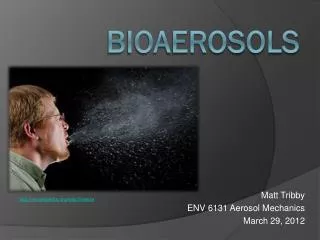
This document discusses bioaerosols generated from compost facilities and their potential effects on human health. Bioaerosols, which include particles of microbial, plant, or animal origin, are ubiquitous in the environment and are commonly found in both indoor and outdoor air. The study presents findings from various research studies examining the dispersion of bioaerosols, especially measuring Aspergillus Funigatus levels in relation to composting processes. It emphasizes occupational health considerations and recommends management practices to mitigate risks for workers and nearby communities.

E N D
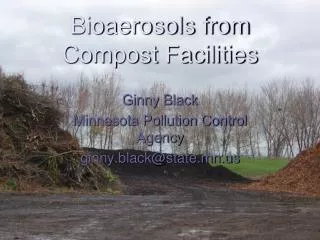
Bioaerosols from Compost Facilities Ginny Black Minnesota Pollution Control Agency ginny.black@state.mn.us
Compost Process • Harness the activity of naturally occurring micro-organisms • Commonly present in soil • Cause the decay of leaves and other organic materials • Main difference is scale/concentration
Aspergllus Funigatus Important in the composting process Recycles Carbon and Nitrogen Present everywhere in the environment 1 to 100 spores - indoor and outdoor air Continuously inhaled by humans Rarely have an adverse effect
Occupational & environmental exposure to bio-aerosols from compost & potential health effects Study parameters Compost Assoc. & Health & Safety Laboratory - UK Twelve studies – dispersion of bio-aerosols from compost sites Monitoring at distances from 0 – 2,300 feet Controls – down and up wind sampling Modeling used Findings 650 – 820 feet background levels
Cornell Waste Mgnt. Institute2007 Emissions & Health Study Variety of bio-aerosols produced at compost facilities A. Fumigatus varies seasonally A. Funigatus is ubiquitous in both outdoor and indoor –pets Bio-aerosols downwind of outdoor compost facilities at background levels from 650-1640’ Bio-aerosol data in sufficient to attribute types and concentrations to specific feedstocks Bio-aerosols are particles of microbial, plant or animal origins (attached to organic dust)
Cornell Waste Mgnt. Institute2007 Emissions & Health Study Many bio-aerosols know to cause symptoms, occasionally illness An association was observed between distance to an outdoor compost facility and respiratory system & general health complaints No distance association with allergies or infectious disease Self-reported symptoms were not correlated with A. Fumigatus levels in the air in the vicinity of a large open-air YW compost facility Compost workers show a response to elevated exposure Occupational exposure to bio-aerosols may be reduced through engineering controls, work practices and personal protective equipment
Management methods • Turning windrows and screening when wind blows away from sensitive “receptors” • Bermsand tree planting • Addition of a biofilter from the top of the windrow to 1/3 down the side of the windrow • Wet windrow while turning • Perform the active part of the process in a building • Screen finished compost in a building • Limit the days and time of day windrows are turned
Thanks you for your Time and Attention Ginny Black 651-757-2233 ginny.black@state.mn.us