Crafting Effective Introductions: Engaging Hooks and Clear Thesis Statements
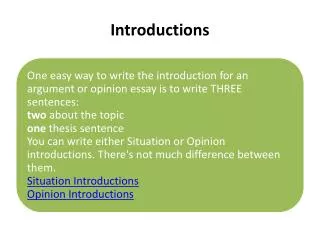
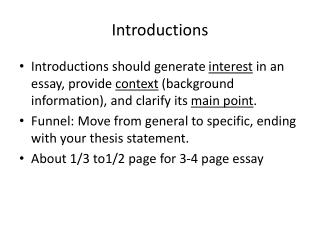
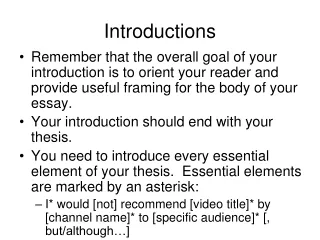
An effective introduction is crucial in engaging your readers from the outset. Begin with a hook that captures attention, followed by essential background information about the topic. This could include anecdotes, quotes, or surprising statistics. Your introduction should culminate in a strong thesis statement, summarizing your main argument while outlining the order of your essay. This process not only lays the foundation for your work but also guides your readers through your arguments, ensuring clarity and connection throughout the piece.

Crafting Effective Introductions: Engaging Hooks and Clear Thesis Statements
E N D
Presentation Transcript
Parts of an Intro • Hook • Background • Thesis Statement
Hook • You need to grab your reader’s attention in a way that still reflects the topic of your essay • Anecdote • Quote • Statistic • Question • Comparison • Surprising Idea or Fact
Background • How to give background • 1-2 sentence summary • Information about the topic • Information about the author • Explanations/Definitions of key aspects of the topic • Discussion of purpose (but don’t announce!) • Discussion of research or other methods used
Thesis • One sentence overview of your idea or argument. • Should reflect the order of your essay • Should go at the end of your introduction • Should be something that could be proven or disproven • Should be general but give some detail on the specific topics the essay will address • DON’T ANNOUNCE
Get started • Your first (written) drafts should go in the “writer’s” section of your notebook • The first draft will be due September 17th(it’s worth 20 points) • Use your outline!!
Parts of the body • Topic Sentence • Explanation • Proof/Example • Concluding Sentence/Response
Topic sentence • Introduces the topic in a clear and succinct way. • Connects to the thesis • “One area that I found challenging last year was creative writing.” • “Another strength of mine was vocabulary.” • Lastly, I was successful at staying organized and completing my reading homework.” • Transition words: Furthermore, In addition, Also, First/Second/Lastly
Explanation • Provide details and analysis about your topic sentence. • Why was this a strength or weakness? What were consequences of your actions? • Transition words: As a result, Therefore, Thus, Consequently
Proof/example • Support your idea/argument with an example or quote. • PROVE to the reader that it is true. • Transition words: For example, This could be seen when, For instance, In particular
Concluding sentence • Wrap up your paragraph and RESPOND to your example • Connect it back to the big picture • Sentence starters: This is important because, This shows, This is why, Because of this, Overall, In general
PARTS OF THE CONCLUSION • Thesis Restated • Summarize your conclusions (what you learned) • Connect to BIG Ideas
Thesis restated • Use a transition • In conclusion, In the end, Through my experiences I have learned, A deep analysis shows • Rewrite your thesis in a different way, placing the focus on what you learned • “Although I did well in vocabulary, I did poorly on reading assignments and homework because I didn’t properly manage my time.”
Summarize • What did you learn • Provide a brief summary of your ideas • Connect to important insights or lessons • In this essay, tell me what you learned from last year and give me your THREE goals for this year
Big ideas • Show your reader WHY this essay is important and matters • Connect to issues in your life or the world (essential questions) • In this essay, tell me your education mission statement • WHY do you educate yourself? WHAT role does education play in your life? • This should be ONE sentence – we’re going to post them in the classroom
Example mission statements • GCAA “Our mission is to serve students with a meaningful, well-rounded education that includes a strong emphasis on the visual and performing arts and a deep commitment to academic excellence. We strongly believe in community engagement, multi-cultural understanding, service and good citizenship.”
Example mission statements • Fox Theater “mission of fostering, promoting, and encouraging young people in the St. Louis region to discover and participate in the joy and wonder of live performances.” • Nike “To bring inspiration and innovation to every athlete in the world.”
Example mission statements • Ms. Murphy “My education mission is to be educated on the world around me, so I can actively participate in it instead of just watching it go by, to
Get started • Your first (written) drafts should go in the “writer’s” section of your notebook • The first draft will be due September 17th(it’s worth 20 points) • Use your outline!!