Understanding Network and Data Link Layer Addressing in TCP/IP Protocols
This document explores the intricacies of addressing in the Data Link and Network layers of the OSI model, focusing on MAC and IP addresses. It discusses the importance of unique identifiers for network nodes and the hierarchical addressing schemes used. Additionally, it covers the various layers of the TCP/IP model, including Transport Control Protocol (TCP) and User Datagram Protocol (UDP), while explaining routing, connectivity, and communication protocols such as FTP, SMTP, and SNMP. The comparison between the OSI model and TCP/IP protocols is also addressed.

Understanding Network and Data Link Layer Addressing in TCP/IP Protocols
E N D
Presentation Transcript
Addressing Through the Layers • Data Link Layer Address • Network Layer Address
Data Link Layer Address • Also calledMAC address, after Media Access Control (MAC) sublayer • Number uniquely defining a network node • Manufacturer-hard codes the address • Block ID • Device ID
Network Layer Address • Resides at Network level of OSI Model • Follows hierarchical addressing scheme • Can be assigned through operating system software • Why would we use BOTH a Network address AND a MAC address?
Data Link Layer Sublayers • LLC • Upper sublayer • Provides common interface • Supplies reliability and flow control services • MAC • Lower sublayer • Appends the physical address of the destination computer onto the frame • IEEE Ethernet and Token Ring differ here
Chapter Three Network Protocols
Chapter Objectives • Identify the characteristics of TCP/IP, IPX/SPX, NetBIOS, and AppleTalk • Understand the position of network protocols in the OSI Model • Identify the core protocols of each protocol suite and its functions • Understand each protocol’s addressing scheme • Install protocols on Windows 95 and Windows NT clients
Introduction to Protocols • Protocols • Rules a network uses to transfer data • Protocols that can span more than one LAN segment are routable • Multiprotocol Network • Network using more than one protocol
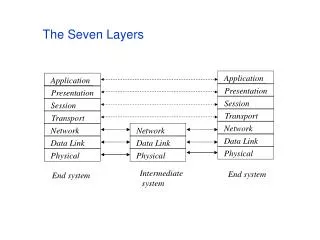
TCP/IP • Transmission Control Protocol/Internet Protocol (TCP/IP) • Suite of small, specialized protocols called subprotocols OSI Model TCP/IP FIGURE 3-1 TCP/IP compared to the OSI Model
TCP/IP Compared to theOSI Model • Application layer roughly corresponds to Application and Presentation layers • Transport layer roughly corresponds to Session and Transport layers • Internet layer is equivalent to the Network layer • Network Interface layer roughly corresponds to Data Link and Physical layers
Internet Protocol (IP) • Provides information about how and where data should be delivered • Subprotocol enabling TCP/IP to internetwork • Traverse more than one LAN segment and more than one type of network through a router • Subnets • The individual networks joined together by routers in an internetwork
Internet Protocol (IP) • IP Datagram • IP portion of a TCP/IP frame that acts as an envelope for data • Contains information necessary for routers to transfer data between subnets TCP FIGURE 3-2 Components of an IP datagram
Internet Protocol (IP) • What is a Datagram? • Packaged data sent without establishment of a communication channel or connection • IP does not guarantee delivery of data • Connectionless • Allows the protocol to service a request without requesting a verified session and without guaranteeing delivery of data
Transport Control Protocol (TCP) • Provides reliable data delivery services • Connection oriented • Requires the establishment of a connection between communicating nodes before the protocol will transmit data • TCP segment • Holds the TCP data fields • Becomes encapsulated by the IP datagram
Transport Control Protocol (TCP) • Port • Address on host where an application makes itself available to incoming data FIGURE 3-3 A TCP segment header
TCP/IP Protocols Telnet, FTP, SMTP, SNMP Application UDP,, TCP Transport Internet IP , ICMP ARP Network Interface
Additional Core Protocols of the TCP/IP Suite • User Datagram Protocol (UDP) • A connectionless transport service • Less overhead than TCP • Internet Control Message Protocol (ICMP) • Notifies the sender that something has gone wrong in the transmission process and that packets were not delivered • No error control • PING uses this
Additional Core Protocols of the TCP/IP Suite • Address Resolution Protocol (ARP) • Obtains the MAC address of a host or node • Creates a local database mapping the MAC address to the host’s IP address • Used in conjunction with IP
TCP/IP Application Layer Protocols • Telnet is used to log on to remote hosts using TCP/IP Protocol • File Transfer Protocol (FTP) is used to send and receive files via TCP/IP • Simple Mail Transfer Protocol (SMTP)is responsible for moving messages from one e-mail server to another, using the Internet and other TCP/IP-based networks • Simple Network Management Protocol (SNMP) manages devices on a TCP/IP network
Addressing in TCP/IP • IP Address • Logical address used in TCP/IP networking • Unique 32-bit number • Divided into four groups of octets (8-bit bytes) • Separated by periods
Addressing in TCP/IP • How did we get the # of hosts? - 28 , 216 , 224 • Though 8 bits have 256 possible combinations, only the numbers 1 through 254 are used to identify networks and hosts • Numbers 0 and 255 are reserved for broadcasts • Transmissions to all stations on a network TABLE 3-1 Commonly used TCP/IP classes (4 exist)
Addressing in TCP/IP • Loopback address • IP address reserved for communicating from a node to itself • Value of the loopback address is always 127.0.0.1 • InterNIC • Authority for Internet IP addressing and domain name registration • Also known as Network Solutions
Addressing in TCP/IP • Firewall • Specialized device • Selectively filters or blocks traffic between networks • May be strictly hardware-based or may involve a combination of hardware and software • Host • Computer connected to a network using the TCP/IP protocol
Addressing in TCP/IP • In IP address 131.127.3.22, to convert the first octet (131) to a binary number: • On Windows 95, click Start, point to Programs, point to Accessories, then click Calculator • Click View, then click Scientific (make sure Dec option button is selected) • Type 131, then click Bin option button • The binary number 131, 10000011, appears in the display window
Addressing in TCP/IP • Static IP address • IP address manually assigned to a device • Dynamic Host Configuration Protocol protocol • Application layer protocol • Manages the distribution of IP addresses on a network
Viewing IP Information • On a Windows 95 workstation connected to a network • Click Start, then click Run • Type winipcfg • (ipconfig /all (NT at DOS prompt) • Click OK • Click More Info • Click OK to close window FIGURE 3-4 Example of an IP configuration window
Addresses and Names • In addition to using IP addresses, TCP/IP networks use names for networks and hosts • Each host requires a host name • Each network requires a network name, also called a domain name • Symbolic name that identifies and Internet domain
IPX/SPX • Internetwork Packet Exchange/Sequenced Packet Exchange (IPX/SPX) • Protocol originally developed by Xerox • Modified and adopted by Novell in the 1980s for the NetWare network operating system • NWLink - Microsoft IPX/SPX emulation FIGURE 3-6 IPX/SPX compared to the OSI Model
IPX/SPX Core Protocols • IPX • Network layer • Connectionless routing • Sequence Packet Exchange (SPX) • Works in tandem with IPX to ensure data are received (and acknowledged): • Whole • In sequence • Error free
IPX/SPX Core Protocols • Service Advertising Protocol (SAP) • Runs directly over IPX • Used by NetWare servers and routers to advertise to entire network which services they can provide • NetWare Core Protocol (NCP) • Handles requests for services between clients and servers • Read for yourself
NetBIOS and NetBEUI • Network Basic Input Output System (NetBIOS) • Originally designed by IBM to provide Transport and Session layer services • Adopted by Microsoft as its foundation protocol • Microsoft added Application layer component called NetBIOS Enhanced User Interface (NetBEUI)
NetBEUI • Fast and efficient protocol • Consumes few network resources • Provides excellent error correction • Requires little configuration • 254 connection limit removed for later versions • Non routable
AppleTalk • Protocol suite used to interconnect Macintosh computers • Originally designed to support peer-to-peer networking among Macintoshes • Can now be routed between network segments and integrated with NetWare- and Microsoft-based networks
Installing Protocols • After installing protocols, they must be binded • Binding • Process of assigning one network component to work with another