

SlideServe
Menu
Préférences
© SlideServe · v2026

Claude Mckay

yanni avatar
8 diapositives · 675 Views · Jul 17, 2014

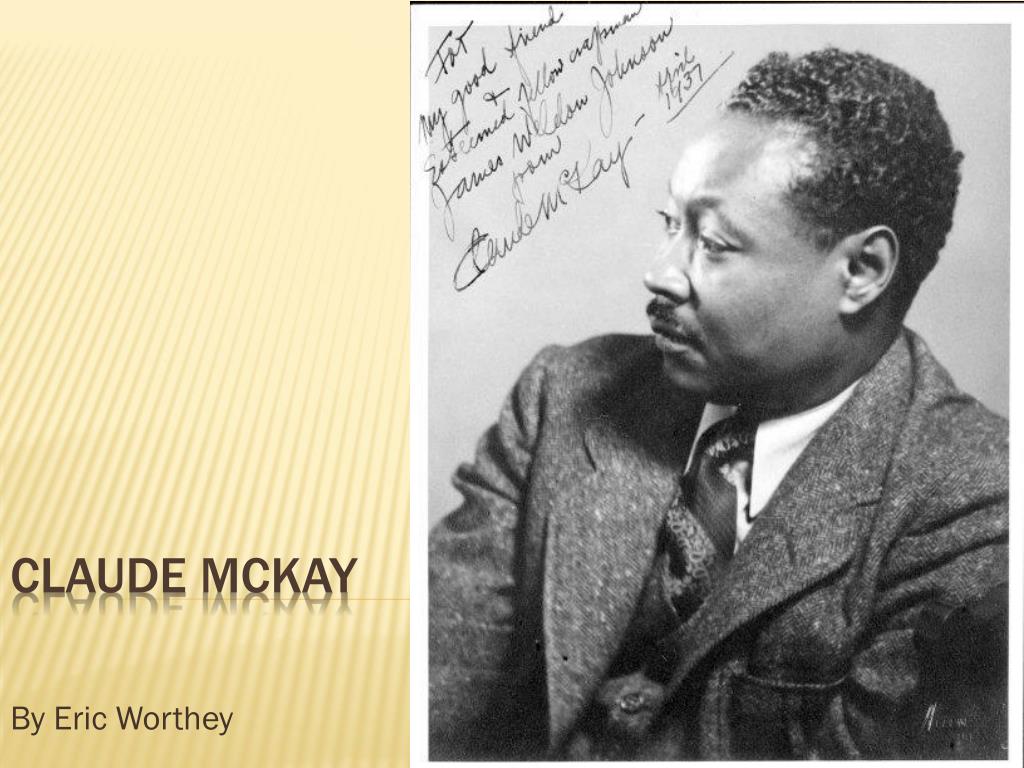
By Eric Worthey. Claude Mckay. was born in Sunny Ville Jamaica, West Indies Was the youngest of 11 Was sent to live and learn from his older brother, Uriah Theodore McKay by the age of 7 Developed a passion for poetry and songwriting by the age of ten
Claude Mckay - slide 1
01 / 8Claude Mckay
1 / 17

Télécharger la présentation

Claude Mckay
Une image / un lien ci-dessous est fourni (tel quel) pour télécharger la présentation

Politique de téléchargement : le contenu du site vous est fourni TEL QUEL pour votre information et votre usage personnel ; il ne peut être vendu, concédé sous licence ni partagé sur d’autres sites sans l’accord de son auteur.Le contenu vous est fourni TEL QUEL, pour votre information et votre usage personnel uniquement. Téléchargez la présentation en cliquant sur ce lien. Lors du téléchargement, si vous ne parvenez pas à télécharger une présentation, l’éditeur a peut-être supprimé le fichier de son serveur.Pendant le téléchargement, si vous ne parvenez pas à obtenir une présentation, le fichier a peut-être été supprimé par l’éditeur.

F I N

Plus de contenu associé

Transcription de la présentation
  1. By Eric Worthey Claude Mckay

  2. was born in Sunny Ville Jamaica, West Indies Was the youngest of 11 Was sent to live and learn from his older brother, Uriah Theodore McKay by the age of 7 Developed a passion for poetry and songwriting by the age of ten Moved to the U.S. in 1912 to pursue professional career and financial gains Background info (September 15, 1889 – May 22, 1948)

  3. Wrote his first poem at ten years old 1906 McKay became apprenticed to Old Brenga (Walter Jekyll) Started to embrace African American roots Changed writing style to accommodate sit-ins and rallies Writing style and influence

  4. attended Tuskegee Institute Encountered extreme racism and switch to Kansas state University W. E. B. Du Bois' “Souls of Black Folk” In 1914 moved to New York and married Eulalie Lewars Began to write for the NAACP and other civil rights groups Began to have a national name as Civil rights Rep. Influence cont.

  5. McKay published two poems in 1917 in The Seven Arts under the pseudonym Eli Edwards “If We Must Die” was published in 1922 in response to the “Red Summer” The poem was reportedly later quoted by Winston Churchill during World War II. founded the semi-secret revolutionary organization, the African Blood Brotherhood Transition to London

  6. Formation of secret groups led to red scare among other activists Moved to London in the fall of 1919 Became a military atheist Was accused of joining communist groups due to well known hatred for American way of government Becoming disillusioned with communism, McKay embraced the social teachings of the Roman Catholic Church, to which he converted in 1944. He died from a heart attack in Chicago at the age of 59. He is regarded as the "foremost left-wing black intellectual of his age" and his work heavily influenced a generation of black authors The Red scare and communism

  7. Poetry Constab Ballads (1912) Harlem Shadows (1922) Selected Poems (1953) Songs of Jamaica (1912) The Dialect Poetry of Claude McKay (1972) The Passion of Claude McKay (1973) Prose A Long Way from Home (1937) Harlem: Negro Metropolis (1940) The Negroes in America (1979) Letters Banana Bottom (1933) Banjo: A Story Without a Plot (1929) Gingertown (1932) Home to Harlem (1928) My Green Hills of Jamaica (1979) Trial By Lynching (1977) Notable Works

  8. Claude McKay." : The Poetry Foundation. N.p., n.d. Web. 01 Dec. 2013. "Claude McKay." - Ask.com Encyclopedia. N.p., n.d. Web. 2 Dec. 2013. <http://www.ask.com/wiki/Claude_McKay>. "Claude McKay." Claude McKay. N.p., n.d. Web. 2 Dec. 2013. <http://www.english.illinois.edu/maps/poets http://www.youtube.com/watch?v=Z9ZYGcTUh7g Works Cited