Download
1 / 49
490 likes | 612 Vues
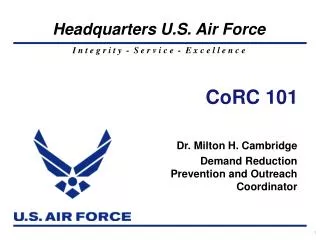
This overview addresses the Community and Outreach Resource Coordination (CoRC) initiative led by Dr. Milton H. Cambridge, focusing on population health services. It emphasizes a leadership-driven 4-tiered approach to prevention, highlighting universal, selected, and targeted strategies to mitigate substance misuse. Key elements include community outreach, assessment, education, and the development of support systems. By implementing best practices and evidence-based strategies, the CoRC aims to engage military and local communities in effective health behavior changes and foster a culture of responsible choices.

E N D
CoRC 101 Dr. Milton H. Cambridge Demand Reduction Prevention and Outreach Coordinator
Overview • Review CoRC Foundational Principles • Comprehensive Community Approach • Leadership Driven ! • CAIB/IDS • 4 Tiered Approach • Universal/Primary Prevention • Selected/Secondary Prevention • Targeted/Tertiary Prevention • CoRC Metrics • CoRC CONOPS and Toolkits: www.afcrossroads.com • 7 Steps of Prevention Planning Process • CoRC Logic Model
Overview • “Best Practices/Lessons Learned” • Ideas for Improving CoRC Implementation
Community Approach toPopulation Health Services Excellent 100% Leadership Supports Health Behavior Change Installation Policies Enhance Health Prevention and Education Helping Agency Support (IDS) POPULATION Primary Care HEALTH Early Intervention Specialty Care Treatment of Disease 0% Poor
Community PreventionModel for Population Health Community Airmen/Families Military Treatment Facility Wing Leadership Installation Support IDS Unit CCs/First Sgt Squadrons Assuring the Conditions For Population Health Public Affairs Academia The Future of the Public’s Health in the 21st Century, November 2002
CoRC:AF Functional Community Players Public Affairs Legal Security Forces Mission Support/ Services Senior Leadership CC/1st Sergeants Chaplains Medical Treatment Facility
2. INDIVIDUAL LEVEL 3.BASE COMMUNITY 4. LOCAL COMMUNITY 1. LEADERSHIP INTEGRATED 4-PRONGED COMMUNITY APPROACH
CoRC Basics 1. Leadership Driven Program: Message and support from top down 2. Individual Level Opportunities for Change • Assessment/Screening of risk in all personnel • Education/awareness • Brief Interventions and treatment when needed • Responsibility and commitment 3. Base Community Opportunities for Change • Develop range of alternate activities • Consistent and equitable detection/enforcement • Media campaign promoting responsibility • Monitor AF metrics/consider base specific metrics 4. Local Community Opportunities for Change • Assess threat and availability of drugs and alcohol • Develop coalition with community agencies
Surgeon General’s Toolkit:Bucket 1 Universal/Primary Prevention • Population outreach: • Screening population/surveillance • Take “temperature” of risk on base • Education and feedback at teachable moments
Surgeon General’s Toolkit:Bucket 2 Selected/Secondary Prevention • Targeted, individualized, non-anonymous alcohol and drug screening at Primary Care and Flight Medicine • PHA: Everyone screened annually, feedback provided, and referred as needed • Routine Care: Options for screening, brief intervention and referral as part of routine care
Surgeon General’s Toolkit:Bucket 3 Targeted/Tertiary Prevention • Screening, Assessment & Brief Intervention • Designed for behavioral health outside of ADAPT • Family Advocacy and Life Skills Support Centers • Tools to identify and treat “sub-clinical” alcohol misuse • Improved identification of substance use disorders • Options for screening at each new intake • Improved decision tree • When to refer to ADAPT and when to incorporate into existing treatment plan
Surgeon General’s Toolkit:Bucket 4 Subject Matter Consultation • Guidance for ADAPT and DDR PMs about their role as CC consultants for CoRC implementation • Booklet with core consultant competencies • References and Resources • Resources and opportunities for training
The 7 Steps of Program Planning • Assess the Readiness of the Community • Assess the Levels of Risks and Protective Factors • Translate the Risk and Protective Factors into Priorities • Examine the Resources in the Community • Select a Target Population • Apply “Best Practices and “Guiding Principles” • Evaluate the Program
AF Readiness Level • Substance Misuse: A Clear and Present Danger • Alcohol Misuse is involved in • 33% of Suicides • 57% of Sexual Assaults • 28.5% of Domestic Violence Incidents • 44% of PMV Accidents • 33% of AD (17-24) commit 81% of ARIs
AF Readiness Level • AD AF FY 04 – 0.45% Drug Positive Rate • Equals – 1,572 AD Airmen Drug Positive • Discharge over 1500 Airmen because Drug Positives • Costs – 36 – 79K to produce each trained Airmen • Cost to the AF – Over 93 Million Dollars per Year
AF Readiness Level • CSAF- Must Reduce ARIs and Drug Positives via The Culture of Responsible Choices (CoRC)- July 2005
Risk Factors AF- Wide • Age (17-24) * • Male* • Availability of Alcohol and Drugs* • Underage Drinking/Binge Drinking* • Single Status • High OPS TEMPO/Deployments • Stress • Sensation-Seeking • High Priority Risk Factors*
Protective Factors AF- Wide • AF is a Family* • Excellent Health Care System* • Healthy Alternatives* • Fitness Activities • First Term Airmen Centers • Network of Helping Professionals* • Opportunities for Education and Training* • High Priority Protective Factors*
Protective Factors AF- Wide • “Wingman’s Culture”* • “Culture of Airmen”* • Suicide Intervention Program* • Enforcement of Underage Drinking Laws* • AF Zero Tolerance Policy* • Strong Leadership* • Implementation of CoRC* • www.afcrossroads.com
Examine Resources • Leadership • ADAPT/DR • Base Prevention Coalitions i.e. • CAIB, IDS, Cross-Functional Oversight, • CoRC Steering Committee under the IDS • Primary Care, Security Forces, OSI, Chaplains, Public Affairs, Health Educators, Family Advocacy, Outreach Managers and Other Helping Professionals
Examine Resources • Off Base Coalitions- Community Anti Drug Coalitions of America (CADCA) • www.CADCA.org • Department of Justice Enforcing Underage Drinking Laws (EUDL) Grants • Community Prevention Agencies • Churches, Schools, etc.
Examine Resources • Center for Substance Abuse Prevention (CSAP) • Model Programs • Online Prevention Training • Centers For The Advancement of Prevention Technologies (CAPTs) • Strategic Prevention Framework (SPF) • National Survey on Drug Use and Health (NSDUH)
Examine Resources • NIAAA 2002 – “A Call to Action” Changing the Culture of Drinking on College Campuses” • National Academy of Sciences, Institute of Medicine (IOM) – “Reducing Underage Drinking: A Collective Responsibility” • Research Triangle Institute (RTI) – “Survey of Health-Related Behaviors Among Military Personnel” (1980 – 2005) • IC & RC
Examine Resources • Other ADAPT and DR Folks • Networking • AF Best “Practices and Lessons Learned” • ADADT/DR World-wide Conferences • CoRC Tactical Communication Plan – Dec 2006 • CoRC Steering Committee • CAIB/IDS • CoRC CONOPS and Toolkits • www.afcrossroads.com
Examine Resources • All 72 SG toolkit documents found at: www.afcrossroads.com • Bucket 1: Resources for universal/primary prevention through population-level outreach and screening • Bucket 2: Resources for selected/secondary prevention through targeted, individualized, non-anonymous alcohol and drug screening at Primary Care/Flight Medicine during PHA and routine care • Bucket 3: Resources for Behavioral Health targeted prevention through assessment for alcohol related problems (misuse, abuse, and dependence) and drug use at all Life Skill's intakes • Bucket 4: Resources for ADAPT/DDR staff to use in their role as the Commanders' substance use subject matter experts
CoRC Target Populations • Primary – 17-24 AD • Secondary - > 24 AD • Tertiary – Civilians, Retirees, and Family Members
Best Practices • CoRC is based on the adaptation of the Best Practice and nationally acclaimed F.E. Warren’s “0-0-1-3” Responsible Drinking Program
Guiding Principles • 2005 CORONA Tasker • Community Prevention Model to Population Health • CoRC 4 Tiers • CSAP 6 Prevention Strategies
Guiding Principles • Prevention Research • NIAAA 2002- “A Call to Action: Changing the Culture of Drinking on College Campuses • IOM 2003 – “Reducing Underage Drinking: A Collective Responsibility”
Evaluation • CoRC Metrics • 25% reduction in ARMs from Baseline Year • 25% reduction in Drug Positives from Baseline Year • Other Measures • Process, Outcome and Impact Program Evaluation
CoRC Logic Model • What are the Risk and Protective Factors to be addressed ? (The Goals) • Reduce ARMs by 25% • Reduce Drug Positive by 25%
CoRC Logic Model • What services and activities will be provided ? • 6 CSAP Prevention Strategies: • Dissemination of Information, Prevention Education, Alternative Activities, Community-based Processes, Environmental Approaches, and Problem Recognition and Referral • Urinalysis – “Smart Testing”
CoRC Logic Model • Who will participate in or be influenced by the program ? • AD 17-24
CoRC Logic Model • How will the activities lead to expected outcomes ? • If CoRC is implemented AF-wide according to the CONOPs than AD 17-24 will be more informed • With Strong Command support and if all 6 CSAP Prevention Strategies and “Smart Testing” are implemented than we will achieve the CoRC goals AF-wide
CoRC Logic Model • What immediate changes are expected for AD ? (The short-term outcomes) • A 25 % reduction in ARMs and UA+s
CoRC Logic Model • What changes will CoRC ultimately like to create? ( The long-term impacts) • A change in the AF Culture
Summary: 7 steps for a Prevention Planning Process • Assess the Readiness of the Community • Assess the Levels of Risks and Protective Factors • Translate the Risk and Protective Factors into Priorities • Examine the Resources in the Community • Select a Target Population • Apply “Best Practices and “Guiding Principles” • Evaluate the Program
CoRC • Best Practices: Kadena Air Base, PACAF
Best Practices • Davis Monthan AFB - EUDL Project, Leadership Tier • Barksdale AFB - Individual Tier • Little Rock AFB - Base Community Tier • Malstrom AFB - EUDL Project, Local Community Tier
Other Best Practices/Lessons Learned • A monthly listing of those turning 21 are sent to First Sergeants from Alpha roster- ACC • Placing 0-0-1-3 stickers on menus and doors of local establishments –ACC • Attending Underage Drinking Task Force and University Task Force Meeting to share ideas and gain synergy – ACC • Responsible Choices through Education, Support and Accountability – USAFE • Integrating CoRC into the Air Commando Culture - AFSOC
Ideas for Improving CoRC Implementation • Strong Leadership Commitment !!! • Implement under CAIB/IDS • Appoint Base-level CoRC POC • Do a local Needs Assessment • Comprehensive Community Approach
Ideas for Improving CoRC Implementation • Add a Best Practices/Lessons Learned section to CoRC Website • Use CoRC CONOPS to train • Periodically Update Toolkits on CoRC Website • Increase the pool of Resources at the CoRC Website