Genetic Algorithms in Computational Seismology for Stellar Evolution Models
160 likes | 260 Vues
Explore the use of genetic algorithms in computational seismology to study stellar evolution models and improve seismic observations. Learn about forward modeling, optimization, and local analysis techniques using genetic algorithms to refine stellar physics models.


Genetic Algorithms in Computational Seismology for Stellar Evolution Models
E N D
Presentation Transcript
Computational Seismology using Genetic Algorithms Travis Metcalfe (NCAR)
Motivation • Why study other stars when we have a much better view of the Sun? • New opportunities to probe the fundamental physics of models • Understanding stellar evolution in a broader context from ages Bedding & Kjeldsen (2003)
Asteroseismology • Only the lowest degree modes are detectable in distant stars (l< 3) • These modes probe deepest into the interior, several dozen excited • Such data will allow low-resolution inversions of the inner 30% of radius Gough & Kosovichev (1993)
Observing techniques Velocity variation (ground) Bouchy et al. (2004) Light variation (space) Aerts et al. (2006)
Example: a Cen A+B Butler et al. (2004) a Cen A • Nearest stellar system, masses slightly above and below solar mass • The range of excited frequencies scales with acoustic cutoff frequency • Amplitudes and mode lifetimes generally agree with expectations Frohlich et al. (1997) Sun Kjeldsen et al. (2005) a Cen B
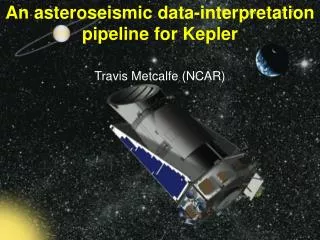
Kepler mission • NASA mission currently scheduled for launch in November 2008 • 95-cm Schmidt corrector, 42 CCDs for planetary transits and seismology • Single field for 4-6 years, 100,000 stars 30 minute sampling, 512 at 1 minute
Forward Modeling • Traditional approach uses “classical” observations to define an error box • Stellar evolution models are adjusted by hand to pass through the box • Seismic observations provide complementary constraints on the models DiMauro et al. (2003)
Optimization Charbonneau (1995)
Genetic algorithms • Generate N random trial sets of parameter values. • Evaluate the model for each trial and calculate the variance. • Assign a “fitness” to each trial, inversely proportional to the variance. • Select a new population from the old one, weighted by the fitness. • Encode-Breed-Mutate-Decode • Loop to step 2 until the solution converges.
Evolution as optimization “Evolution is cleverer than you are.” – Francis Crick
MPIKAIA package • General purpose F77 model-fitting optimization subroutine • Slight modification of the serial version of PIKAIA with additional MPI code • Distributed with Makefile and submission script for supercomputers http://mpikaia.asteroseismology.org/
Local analysis: SVD • We use each GA result as a “first guess” for the local analysis • SVD probes information content of the classical and seismic observables • Levenberg-Marquardt method for optimization and covariance matrix Creevey et al. (2007)
Hare & Hound: GA • First 128 models match the input frequencies to about 1-2 microHz • Initial convergence driven by the crossover operator (first ~30 generations) • Subsequent improvement from a random favorable mutation operation
Hare & Hound: SVD • GA found the closest match possible, given the search resolution • SVD improved estimate of M and X, with other parameters comparable • Both within the typical uncertainties of the “classical” observables
Summary • Asteroseismology can calibrate the physics of solar / stellar models, much as helioseismology improved the standard solar model • Space missions such as CoRoT and Kepler will soon unleash a flood of stellar pulsation data with unprecedented quality • The genetic algorithm method can and should be applied to different areas of seismology, for many forward modeling problems