Understanding Doppler Effect for Light: Theory and Application
Learn about the Doppler Effect in light, time dilation, red and blue shifts, and how it applies to astronomy and radar systems. Includes formulas and calculations for speed determination.

Understanding Doppler Effect for Light: Theory and Application
E N D
Presentation Transcript
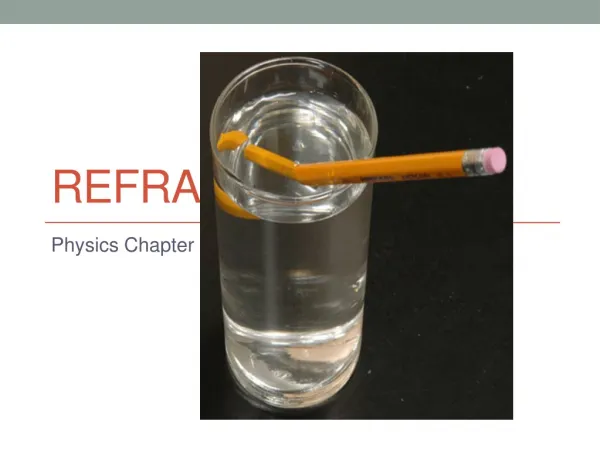
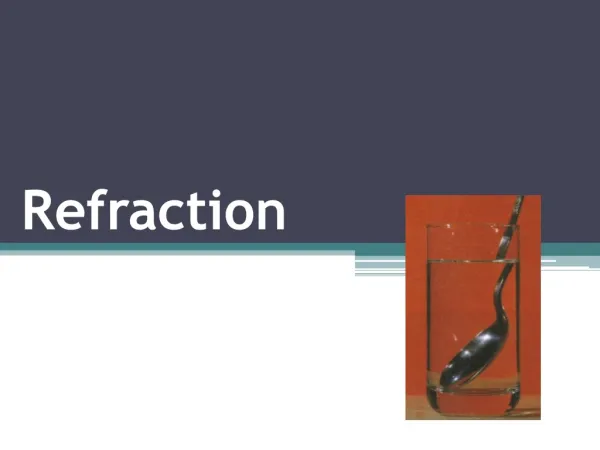
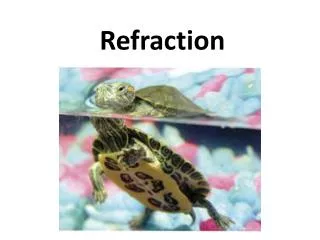
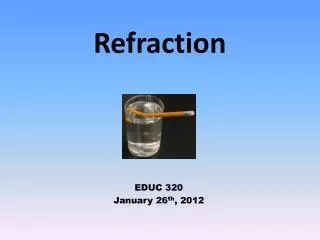
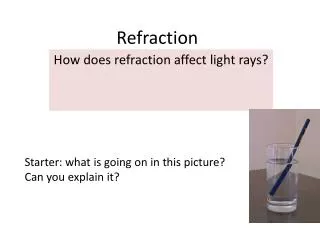
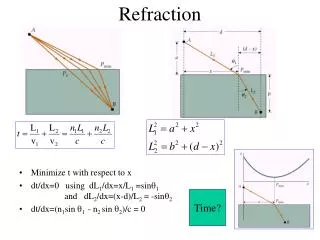
Refraction • Minimize t with respect to x • dt/dx=0 using dL1/dx=x/L1 =sin1 and dL2/dx=(x-d)/L2 = -sin2 • dt/dx=(n1sin 1 - n2 sin 2)/c = 0 Time?
n1 sin 1 = n2 sin 2 2=/2 ==> sin c = n2/n1 Water n=1.5 Air n=1. c= 41.80 Reflection refraction
Doppler Effect for Light • Recall for mechanical waves that all speeds are with respect to a “medium” • detector fixed and source moving away: f ` =f [ 1/(1+vs/v)] < f • source fixed and observer moving away: f ` =f ( 1- vd/v) < f • note: f ` and f ` are different even if vs=vd
Doppler Effect at Low Speeds • f ` = f [(v vD) /(v vS)] • 1/(1+x) ~ 1 - x + … • 1/(1-x) ~ 1 + x + ... • if vS <<v and vD <<v , then f ` ~ f ( 1 u/v) where u = | vS vD | is relative speed of source with respect to detector
Doppler Effect for Light • can we use the same result for light by replacing v by c ? c=3.00 x 10⁸ m/s • f `= f ( 1 ± u/c) higher if approaching! u<<c • in astronomy we measure wavelengths • c = f = `f ` • `= / ( 1 ± u/c) • ( `- )/ ~ u/c Doppler shift • decrease => blue shift => f ` increase=>approach • increase => red shift => f ` decrease => receding • light from all distant galaxies is red shifted • => moving away?
Doppler Effect for Light • =u/c • For source and detector separating • f = f0 (1-2)1/2/(1+)red shift > 0 • = f0 (1-)1/2/(1+ )1/2 • For source and detector approaching • f = f0 (1+ )1/2/(1- )1/2blue shift < 0
Doppler Effect for Light = u/c • For light, v=c • no medium is needed • both cases should be the same • Doppler effect for light depends only on the relative velocity of the source and detector • time dilation is important f ` < f0 if separating Police radar uses microwaves => needs relativistic formula
Doppler Effect • Car approaching: light (radar) travels at speed c Same as for sound but involves different shifts!
Problem • A radar device emits microwaves with a frequency of 2.00 GHz. When the waves are reflected from a car moving directly away from the emitter, a frequency difference of 293 Hz is detected. Find the speed of the car. • 1. The frequency f received by the car is given by f = f0 (1- )1/2/(1+ )1/2 = v/c • 2. The car now acts as the source, sending signals of frequency f to the stationary radar receiver. • 3. Consequently, frec = f (1- )1/2/(1+ )1/2 =f0 (1- )/(1+ )f0 (1- 2)since v<< c. • 4. Solve for v: v/c= f/2f0 v= (3x108x293/(4x109 ) m/s = 22 m/s = 79.2 km/h
Transverse Doppler Effect • In previous cases, the relative motion was along the line connecting the source and receiver • in general the relative velocity could be at some angle to this line • time dilation only depends on the magnitude of