Mobile Technology in Ships Inspections
160 likes | 276 Vues
This paper discusses DNV's exploration of mobile technology applications in ship inspections, aimed at improving efficiency and accuracy in the maritime sector. It covers the current inspection process involving around 1,200 inspectors and 25,000 annual inspections, leveraging a centralized database called Nauticus. Key insights into wearable technology, data collection, and electronic reporting will be examined, highlighting the challenges faced and potential business benefits, including improved service quality and reduced errors.


Mobile Technology in Ships Inspections
E N D
Presentation Transcript
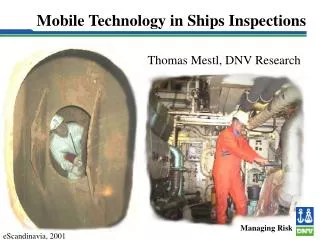
Mobile Technology in Ships Inspections Thomas Mestl, DNV Research Managing Risk eScandinavia, 2001
Maritime Industries 38% General Industries 37% Oil, Gas & Processes 22% Other 3% Maritime business: a cornerstone in DNV • 5.000 ships classified by DNV (about 15% of World's fleet) • 1.200 ship inspectors • doing ca. 25.000 ships inspection annually • required time per inspection: hours 1-2 days
Product model technology: a database containing all info about a ship from new-building, operation to scraping: NAUTICUS, central information repository • technical drawings • 3-D models • info about material, equipment & inventory, • required certificates, etc. • inspection findings and reports • repairs
Typical inspection work process Preparation in office Nauticus Checklist, and relevant info Inspection on ship Data collection Reporting Office: entering data into db, issuing (temporary) certificate(s)
Note book and pencil Flashlight Hammer Nauticus Checklist Gloves & Hardhat Mobile phone Surveyor - unchanged through centuries...
Problem areas • Info available in office or on paper - copy on Laptop • Checklists on paper - double work - source of errors • New inspections are prioritised rather then finishing up old ones - pile up of unfinished work (customer satisfaction?) - employees dissatisfied • Knowledge repository not accessible on site
What does DNV do? • DNV Research: Project that examines the potential of mobile technology in ships inspection • wearable computer technology • Pocket PCs • IT Department: • Product model technology • Light clients, Microsoft .net • Database accessible through IE browser
Wearable Computer Technology (WCT) • A compressed ThinkPad 560X from IBM: • 64MB Ram • 340MB disc • Colour 1024x860 pix. • 300 g • Win. 98
WCT adapted to DNV usage Built-in camera Headmounded display Mouse Microphone Wearable PC from IBM Mouse Keyboard
Electronic check lists and on site reporting Recorded conditions • Additional comments • as: • text file • sound file • picture file Keyboard interface Camera interface Sound recorder Guidance notes
Lessons learned • Hardware • Hardware should be “hidden” and must be hardened • Head-mounted display is excellent when looking at technical drawings but one cannot share screen • Software • must be specially adapted to wearable usage (no mouse) • integrated functionality (simplicity) • extreme requirements to user friendliness (screen size, data entry, navigation) • User • cannot ask “What do you want?”, must ask “ what’s wrong?” • resistance to new technology, involve and prepare user • proud, show-off (James Bond) Experience directly transferable to other technologies: PDA
Business Potential • Effectiveness: • no reduction in inspection time! • utilising spare time (waiting or travel time) • collect data in electronic form • integrates into business processes, • knowledge management systems, • electronic integration with customers • reduce double work, e.g. less errors
Business Potential (cont.) • Quality of service: • faster delivery • higher quality service (less errors) • better advisory due to instant access to information Detention ratio
Business Potential (cont.) • Image • valued employees, increased motivation • profiling DNV as a high tech company on the cutting edge • PR