Download
1 / 4
40 likes | 205 Vues
This chapter delves into x-ray emission, focusing on the measurement of x-ray output in air with units in roentgens. Key factors affecting x-ray quantity include mAs, kVp, distance, and filtration. The direct relationship between mAs and x-ray quantity is emphasized, along with the proportionality of x-ray quantity to the square of the kVp ratio. The inverse square law addresses distance effects, while filtration is discussed for its role in increasing beam hardness and overall quality, crucial for effective imaging in radiological practices.

E N D
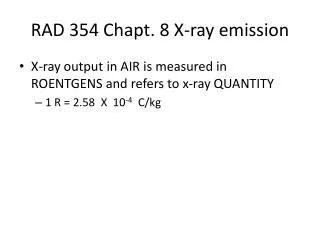
RAD 354 Chapt. 8 X-ray emission • X-ray output in AIR is measured in ROENTGENS and refers to x-ray QUANTITY • 1 R = 2.58 X 10⁻⁴ C/kg
4 Factors affect the QUANTITY of RADIATION: mAs, kVp, distance & filtration • mAs – DIRECTLY proportional to the x-ray quantity • kVp – x-ray quantity varies proportional to the SQUARE of the RATIO of the kVp • Distance – Inverse square law • Filtration – Absorbs/Attenuates the LOW energy LONG wavelength photons – INCREASES average hardness of the beam
X-ray QUALITY = Penetrability • INCREASED hardness = INCREASED penetration and DECREASED wavelength • Measured via HALF VALUE LAYER (HVL = BEST measure of x-ray QUALITY) • Penetrometer/step wedge • Filtration – used to harden the beam and absorb the “useless, long wave photons” • Inherent (.5 mm al) Added = 2 mm al (70-80 kVp)
“Special” Filters • Trough – for CXR’s • “Bow Tie” – for some generations of CT • Wedge – for use with an AP foot, etc. • Conic – for digital fluoro • Don’t reduce patient dose, but improve the image