
Uploaded by
yul
0 SLIDES
97 VUES
0LIKES
Understanding Business Ownership in Manufacturing
DESCRIPTION
Learn about business ownership in manufacturing, including the role of capital in setting up and running a successful venture. Explore key concepts and strategies for making products for profit in the manufacturing industry.
Download

1 / 0
Télécharger la présentation 
Understanding Business Ownership in Manufacturing
An Image/Link below is provided (as is) to download presentation
Download Policy: Content on the Website is provided to you AS IS for your information and personal use and may not be sold / licensed / shared on other websites without getting consent from its author.
Content is provided to you AS IS for your information and personal use only.
Download presentation by click this link.
While downloading, if for some reason you are not able to download a presentation, the publisher may have deleted the file from their server.
During download, if you can't get a presentation, the file might be deleted by the publisher.
E N D
Presentation Transcript
-
Manufacturing
- Manufacturing - Making products to be sold for profit
- Business Ownership Before we can talk about business ownership we need to define the word Capital: Capital – Money, buildings, machinery and investments that are used to make products or services
- Business Ownership Sole Proprietorship – business owned by one person Partnership – business owned by more than one person Corporation – large number of people own a company
- Types of production - Craft or Cottage system – make products at home and take them to the marketplace
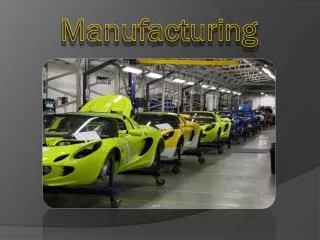
- Mass Production - Assembly-line method– many people work together doing different specialized jobs to produce one product
- Modern day assembly line
- Who is known for coming up with the idea of an assembly line? Henry Ford (early 1900s)
- Concepts related to mass production - Interchangeable Parts – all parts are made the same; they can be interchanged
- Who was responsible for the concept of interchangeable parts? Eli Whitney What else is Eli Whitney known for inventing?
- Cotton Gin He was known for many other inventions as well?
- Labor Specialization – each person has a specialized job to do Time and motion analysis - studies are done to reduce wasteful practices
- Some Vocabulary: Industry – Businesses that produce goods or services
- Goods – Products that are made
- Services – Work performed to improve goods or benefit people
- Labor – human workers
- Free Enterprise – A political system that allows business to flourish with as little government control as possible
- Entrepreneur – Organizer of an enterprise. Takes advantage of new opportunities
- Monopoly – Business which is the only producer of a good or service; one which has no competition
- Efficiency – Getting the most out of what was put in
- Assembly – Fitting together of parts to produce manufactured goods
- Natural Resources – Items taken from the earth, sea or air. Examples: oil, iron ore, cotton, wood, fruits, natural gas, oxygen
- Durable Goods – Products that usually last at least three years. Examples: furniture, refrigerators, automobiles, bikes etc
- Nondurable Goods – Products that usually last fewer than three years. Examples: clothing, food, toothpaste etc Middle school romances
- Now take the practice Quiz: www.quia.com/quiz/593377.html

More Related