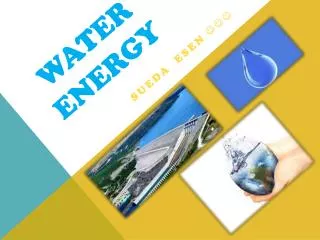
Water Energy
Hydro energy has been utilized for over 2,000 years, with the ancient Greeks employing water wheels to grind wheat into flour. This historical technology has evolved into modern hydroelectric power stations. The process begins with a dam that creates a reservoir, allowing gravity to pull water through a penstock to a turbine. As water strikes the turbine blades, it generates electricity via a connected generator. The generated alternating current is transformed to higher voltage and transmitted through power lines, while the used water is returned downstream.

Water Energy
E N D
Presentation Transcript
Hydro energy in history More than 2,000 years ago, the Greeks are said to have used a water wheel for grinding wheat into flour. These ancient water wheels are like the turbines of today, spinning as a stream of water hits the blades. The gears of the wheel ground the wheat into flour.
Various types of water energy overshot undershot Hydro-electric station
How does it work? Dam - a dam holds back water, creating a large reservoir. Intake - Gates on the dam open and gravity pulls the water through the penstock, a pipeline that leads to the turbine. Water builds up pressure as it flows through this pipe. Turbine - The water strikes and turns the large blades of a turbine, which is attached to a generator above it by way of a shaft. Generators - As the turbine blades turn, so do a series of magnets inside the generator. Giant magnets rotate past copper coils, producing alternating current (AC) by moving electrons. Transformer - The transformer inside the powerhouse takes the AC and converts it to higher-voltage current. Power lines - Out of every power plant come four wires: the three phases of power being produced simultaneously plus a neutral or ground common to all three Outflow - Used water is carried through pipelines, called tailraces, and re-enters the river downstream.