Designing Iron Alloys to Mimic Nickel-Based Superalloys with Coherent Precipitates
This essay will explore the design of iron alloys to emulate nickel-based superalloys by incorporating ordered precipitates that are coherent with the matrix. By examining the crystallographic structures, interstitial solutions, and the effects of carbon in both ferrite and austenite phases, this paper will highlight the potential for achieving enhanced mechanical properties typical of superalloys. The study will reference advanced concepts in solid solution strengthening and the characterization of various interstitial sites to inform alloy design strategies.

Designing Iron Alloys to Mimic Nickel-Based Superalloys with Coherent Precipitates
E N D
Presentation Transcript
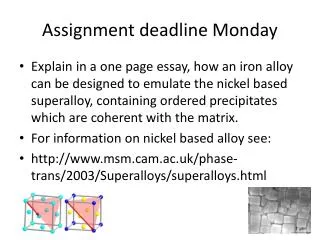
Assignment deadline Monday • Explain in a one page essay, how an iron alloy can be designed to emulate the nickel based superalloy, containing ordered precipitates which are coherent with the matrix. • For information on nickel based alloy see: • http://www.msm.cam.ac.uk/phase-trans/2003/Superalloys/superalloys.html
Crystallography H. K. D. H. Bhadeshia Interstices in Cubic-I, Cubic-F and HCP Structures
(Andrew Fairbank) C 62 pm Ni 126 pm Fe 124 pm Cr 130 pm
carbon in iron silicon in iron
Insterstitial solid solution strengthening (Ghosh & Olson)
Cubic-I Ferrite Close-packed direction? (Andrew Fairbank)
octahedral interstice in ferrite point group symmetry? Carbon does not fit. Therefore, placing in octahedral site reduces the tetragonality of the site.
tertrahedral interstice in ferrite Vector joining centres of iron and carbon?
Structure projection of 4 unit cells of ferrite What it the vector joining iron and carbon atom neighbours? y x
3 octahedral sites per Fe 6 tetrahedral sites per Fe
austenite cubic-F
octahedral interstice in austenite point group symmetry? Carbon does not fit. It causes uniform expansion.
tertrahedral interstice in austenite Vector joining centres of iron and carbon?
Insterstitial solid solution strengthening (Ghosh & Olson)
ferrite austenite
Ferrite • Carbon in “smaller” anisotropic octahedral interstices • Resulting strain is anisotropic • Strong interaction with deviatoric and dilatational strain fields of dislocations • Intense strengthening • 3 octahedral and 6 tetrahedral holes per iron
Austenite • carbon in larger isotropic octahedral interstices • therefore, behaves like substitutional solute with weak interactions with dislocations • mild strengthening • 1 octahedral and 2 tetrahedral holes per iron
b a 3 3 a 2 b b 2 1 a 1 (a) (b) BAIN STRAIN (d) (c) Body-centered Body-centered cubic martensite tetragonal austenite