
SlideServe
Menu
Préférences
© SlideServe · v2026

Composing in the 21st Century

yves avatar
9 diapositives · 414 Views · Dec 05, 2012

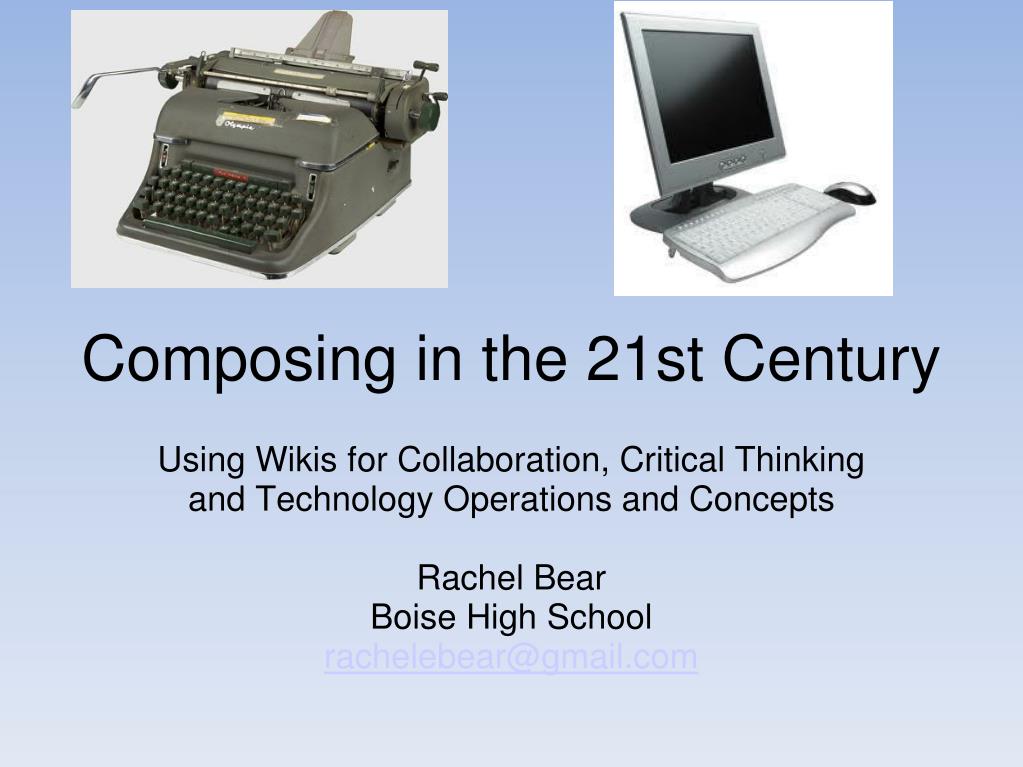
Composing in the 21st Century. Using Wikis for Collaboration, Critical Thinking and Technology Operations and Concepts Rachel Bear Boise High School rachelebear@gmail.com. America's students are "ill prepared for the demands of today's (and tomorrow's) workplace.”
Composing in the 21st Century - slide 1
01 / 9Composing in the 21st Century
1 / 17

Télécharger la présentation

Composing in the 21st Century
Une image / un lien ci-dessous est fourni (tel quel) pour télécharger la présentation

Politique de téléchargement : le contenu du site vous est fourni TEL QUEL pour votre information et votre usage personnel ; il ne peut être vendu, concédé sous licence ni partagé sur d’autres sites sans l’accord de son auteur.Le contenu vous est fourni TEL QUEL, pour votre information et votre usage personnel uniquement. Téléchargez la présentation en cliquant sur ce lien. Lors du téléchargement, si vous ne parvenez pas à télécharger une présentation, l’éditeur a peut-être supprimé le fichier de son serveur.Pendant le téléchargement, si vous ne parvenez pas à obtenir une présentation, le fichier a peut-être été supprimé par l’éditeur.

F I N

Plus de contenu associé

Transcription de la présentation
  1. Composing in the 21st Century Using Wikis for Collaboration, Critical Thinking and Technology Operations and Concepts Rachel Bear Boise High School rachelebear@gmail.com

  2. America's students are "ill prepared for the demands of today's (and tomorrow's) workplace.” (Workforce Readiness Report, Partnership for 21st Century Skills) "we must ask ourselves:  are the most basic knowledge skills still practical and relevant to our students in this technologically evolving twenty-first century?“ (Kathriner, 2006) Framework for 21st Century Learning

  3.  "we should not just review our curricula, but our everyday lessons for relevance, for some connection between students' education, experiences and future" and realize that "a superior tool giving us superior access still does not constitute deep thinking or understanding" because "computers cannot substitute for substance“ (Kathriner, 2007) Consider the Research

  4. Communication and Collaboration Students use digital media and environments to communicate and work collaboratively, including at a distance, to support individual learning and contribute to the learning of others.  Students:     1.interact, collaborate, and publish with peers, experts,                                  or others employing a variety of digital environments and media.     2.communicate information and ideas effectively to              multiple audiences using a variety of media and          formats.     3.develop cultural understanding and global          awareness by engaging with learners of other cultures.     4.contribute to project teams to produce original works          or solve problems. (International Society for Technology in Education)

  5. Students use critical thinking skills to plan and conduct research, manage projects, solve problems and make informed decisions using appropriate digital tools and resources.Students:    1.  Identify and define authentic problems and significant questions for investigation    2.  Plan and manage activities to develop a situation or complete a project    3.  Collect and analyze data to identify solutions and/or make informed decisions    4.  Use multiple processes and diverse perspectives to explore alternative solutions (International Society for Technology in Education) Critical Thinking

  6. Technology Operations and Concepts Students demonstrate a sound understanding of technology concepts, systems, and operations.  Students:      1.understand and use technology systems.     2.select and use applications effectively and                      productively. 3.troubleshoot systems and applications. 4.transfer current knowledge to learning of new          technologies.         (International Society for Technology in Education)

  7. For All Units • Discussion of the same or different readings outside boundaries of class period • Structured but allows for choice  • Mastering "rules" for composing in this mode • length and content • "webiquette" • discussion rather than "post" • Online Discussion Example Meaningful Use of Technology--Online Discussions

  8. The Archetype/Allusion Research Project • Essential Question for Unit:  How Do Stories Matter? • Collaborative--in groups, but also across class periods • Format and Audience--presentation to peers, same information in Wiki Doc • Selecting and Using Technological Tools and Systems--editing a page, embedding videos and songs, uploading documents, etc. • Example

  9. Essential Question for Unit:  Whose Story Gets Told? • Collaborative Composing--not limited by class period • Blending of Writing • Blending of Modes--collaborative problem solving, working with complex features of technology • Example #1 • Example #2 The Multi-Modal Essay