Pulmonary Function Tests
This detailed guide explores various pulmonary function tests and lung mechanics essential for understanding respiratory health. It covers aspects like lung resistance and compliance, distribution of ventilation, maximal respiratory pressures, and the V/Q ratio. Measurement techniques such as nitrogen washout, inert gas dilution, and plethysmography are discussed. The impact of lung volume on airway resistance is also analyzed, along with exercise-induced respiratory challenges and mechanisms of hypoxemia. This information serves as a foundational resource for healthcare professionals assessing lung function.

Pulmonary Function Tests
E N D
Presentation Transcript
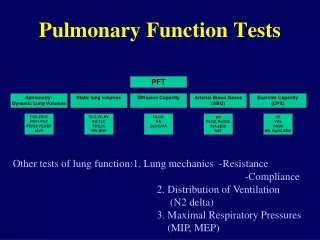
Pulmonary Function Tests Other tests of lung function:1. Lung mechanics-Resistance -Compliance 2. Distribution of Ventilation (N2 delta) 3. Maximal Respiratory Pressures (MIP, MEP)
How to measure FRC (RV,TLC) ? • Nitrogen washout method • Inert gas dilution technique • Plethysmography
Volume dependence of airway resistance (Raw) 4 3 SRaw (cmH2O/L/sec) 2 1 0 2 4 6 8 Lung Volume (liters) RV TLC
Ventilatory Mechanics: Healthy 100 % VC Pcw 80 PRS 60 40 PL 20 0 20 40 60 -60 -40 -20 0 Pressure (cmH2O)
4 3 2 SRaw (cmH2O/L/sec) 1 0 2 4 6 8 Lung Volume (liters) Ventilatory Mechanics: Healthy ΔPΔV 100 ΔP ΔV % VC RV 80 elastic WOB 60 elastic and resistive work of breathing is minimized when tidal breathing occurs within the compliant portion of the respiratory systems P-V curve TLC 40 ΔPΔV 20 resistive WOB 0 20 40 60 -60 -40 -20 0 Pressure (cmH2O) SRaw as lung volume because the airways distend as the lungs inflate, and bigger airways have lower resistance (*Poiseuilles’ Law*). The opposite is also true, of course!
Ventilatory Mechanics: Healthy Begin Exercise IC IC VT
8 EILV 6 Volume (liters) 4 EELV 2 0 -40 -30 -20 -10 0 10 20 30 40 50 Pressure (cmH20) Ventilatory Mechanics: Healthy TLC IRV IC VT EELV RV
Respiratory and metabolic shifts chronic acute acute chronic
Exercise tests in lung diseases • Exercise-induced asthma (EIA) - FEV1 • Interstitial lung disease (ILD)- SAT • Exercise tolerance in rehabilitation (COPD) - cardiopulmonary exercise (CPX). Important variables: - work rate (watts), SpO2, ABG - VO2, VCO2, RQ, VE - lactate threshold (LT) - breathing reserve (1-VEmax/MVV) - heart rate reserve (1-HRmax/220-age)
Mechanism of exercise-induced hypoxaemia
Noninvasive determination of lactate threshold by the V-slope method