Understanding Trapezoids: Properties, Area, and Perimeter
This informative guide explains the characteristics of trapezoids, a type of quadrilateral with one pair of parallel sides. Learn about the bases and legs of trapezoids, how to calculate their area using a simple formula, and discover the unique properties of isosceles trapezoids, including their angle measures. The guide also provides insights into the mid-segment and how to calculate the perimeter. Ideal for students and enthusiasts of geometry, this resource simplifies trapezoid concepts for better understanding.


Understanding Trapezoids: Properties, Area, and Perimeter
E N D
Presentation Transcript
Trapezoid By Christian Ornelas
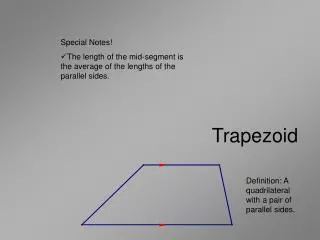
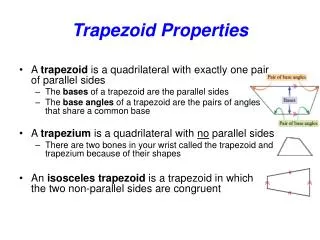
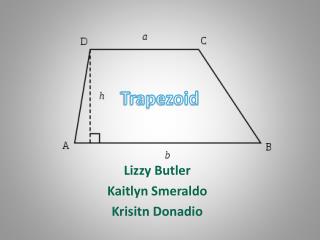
Bases and Legs • Bases • The two parallel lines are called the bases. In the picture below, AD and BC are the bases. • Legs • The two non parallel lines are called the legs. In the picture below, AB and CD are the legs.
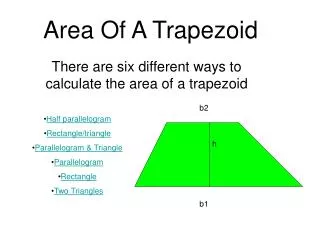
The area of a trapezoid • To find the area, you need to: • 1. Add both of the bases together. • 2. Divide the sum by two. • 3. Multiply that by the height.
Mid-Segment • The mid-segment (EF) is the segment that joins the midpoints of the non-parallel sides (AB and CD). • Its length is equal to the average of the lengths of the bases (AD and BC) of the trapezoid.
Isosceles Trapezoid • An isosceles trapezoid means that the base angles have the same measure. • The other pair of opposite angles also have the same measure.
Perimeter of a Trapezoid • The perimeter of a trapezoid is the sum of all the sides: • P = a + b + c + B
Adjacent angles • The angles on the same side of a leg are called adjacent angles. • NML and MLO are supplementary. • For the same reason, MNO and NOL are supplementary.