Download
1 / 19
190 likes | 291 Vues
Discover the fundamentals of atomic and molecular structures, chemical formulas, and bonding geometries in this comprehensive exploration of compounds and elements. Uncover how atoms bond and shape our daily experiences, as we delve into the significance of chemistry in our lives. Join us on Friday, 10/27, as we delve into the wave model of atoms, molecular families, and instrumentation. Participate in engaging questions like identifying compounds and understanding the differences between pure substances and elements. Explore reactivity, bonding in metals, semiconductors, ionic, and covalent bonds, and their practical applications. Delve into molecular vibrations, molecular orbitals, infrared absorption, mass spectroscopy, and crystallization processes.

E N D
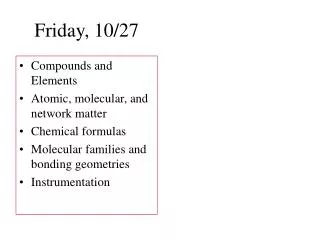
Compounds and Elements Atomic, molecular, and network matter Chemical formulas Molecular families and bonding geometries Instrumentation Friday, 10/27
Compounds and Elements Atomic, molecular, and network matter Chemical formulas Molecular families and bonding geometries Instrumentation (?) The wave model tells us what atoms are like We can understand how atoms bond These bonds are a major part of our daily experience. Our lives are governed largely by chemistry Friday, 10/27 Why we’re doing this
10/27 Atoms molecules and networks 10/30 Reactivity 11/1 Bonding in metals and semiconductors 11/3 Ionic bonds 11/6 Covalent bonds 11/8 Some applications The wave model tells us what atoms are like We can understand how atoms bond These bonds are a major part of our daily experience. Our lives are governed largely by chemistry Our approach Why we’re doing this
(Participation question)Which of these is a compound? • Hydrogen • Neon • Nitrogen • Water Compounds: matter that contains two or more atoms in a fixed, definite proportion. Sulfuric acid, hydrogen peroxide, salt, sugar, bleach, sodium bicarbonate, etc.
(Participation Question)What is the difference between a pure substance and an element? • They are the same thing • Pure substances have a defined, unchanging chemical composition, but elements are just one kind of atom. • Elements have a defined, unchanging chemical composition, but pure substances are just one kind of atom.
Atomic Matter: The noble gases Simple atoms in solid, gas, and liquid state Chemical Matter “I told you they’s organized”
Definite molecules in solid, liquid, and gaseous states Atomic Matter: The noble gases Simple atoms in solid, gas, and liquid state Molecular matter “I told you they’s organized”
Definite molecules in solid, liquid, and gaseous states Extended bonding, no distinct molecles. Metals, salt, quartz, etc. Molecular matter Network matter
molecular atomic molecular network Can you tell how bonding influences melting and boiling temperatures?
(Participation question)How many hydrogen atoms:H2O • 1 • 2 • 3 • 4 • 5
(Participation question)How many hydrogen atoms:2C2H4 • 2 • 4 • 6 • 8 • 10
The family of simple hydrocarbons http://ps100.byu.edu/molecule_sg/simple_hydrocarbons.html
Electrons in molecules have NEW standing wave descriptions Sometimes we talk about shared pairs of electrons Molecular Orbitals
Electrons in molecules have NEW standing wave descriptions Sometimes we talk about shared pairs of electrons Molecular Orbitals Molecules vibrate
Molecular vibration can be caused by photon absorption Infrared Absorption Molecules vibrate
Molecular vibration can be caused by photon absorption Infrared Absorption Molecules break
Measure molecular fragments to determine the original molecule Mass Spectroscopy Molecules break
Measure molecular fragments to determine the original molecule Some molecules can be formed into crystals Crystal form and content determined by x-ray scattering Mass Spectroscopy Molecules crystallize