

SlideServe
Menu
Préférences
© SlideServe · v2026

SUBJECT:

zagiri avatar
11 diapositives · 286 Views · Sep 11, 2014

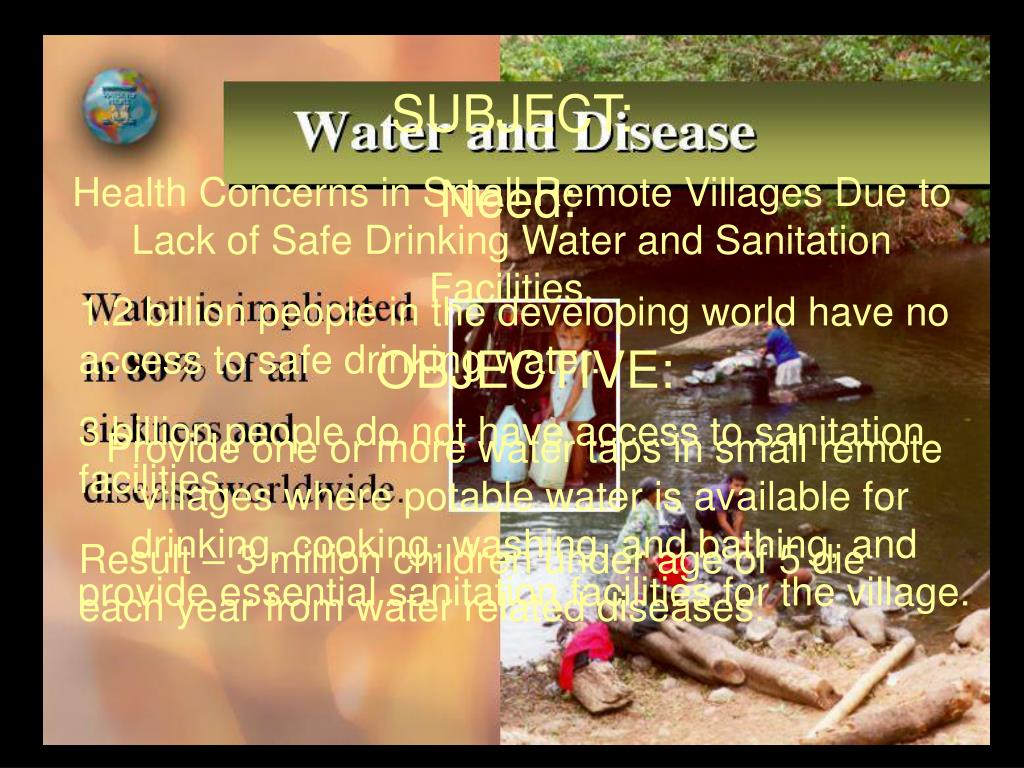
SUBJECT: Health Concerns in Small Remote Villages Due to Lack of Safe Drinking Water and Sanitation Facilities. Need:. 1.2 billion people in the developing world have no access to safe drinking water. OBJECTIVE:
SUBJECT: - slide 1
01 / 11SUBJECT:
1 / 17

Télécharger la présentation

SUBJECT:
Une image / un lien ci-dessous est fourni (tel quel) pour télécharger la présentation

Politique de téléchargement : le contenu du site vous est fourni TEL QUEL pour votre information et votre usage personnel ; il ne peut être vendu, concédé sous licence ni partagé sur d’autres sites sans l’accord de son auteur.Le contenu vous est fourni TEL QUEL, pour votre information et votre usage personnel uniquement. Téléchargez la présentation en cliquant sur ce lien. Lors du téléchargement, si vous ne parvenez pas à télécharger une présentation, l’éditeur a peut-être supprimé le fichier de son serveur.Pendant le téléchargement, si vous ne parvenez pas à obtenir une présentation, le fichier a peut-être été supprimé par l’éditeur.

F I N

Plus de contenu associé

Transcription de la présentation
  1. SUBJECT: Health Concerns in Small Remote Villages Due to Lack of Safe Drinking Water and Sanitation Facilities. Need: 1.2 billion people in the developing world have no access to safe drinking water. OBJECTIVE: Provide one or more water taps in small remote villages where potable water is available for drinking, cooking, washing, and bathing, and provide essential sanitation facilities for the village. 3 billion people do not have access to sanitation facilities. Result – 3 million children under age of 5 die each year from water related diseases.

  2. CURRENT SOURCES OF DRINKING WATER: Water Sources – Wells, Springs, Streams, Rain Water. Water Supply - Available, Adequate, Treatable. Quality of the Water – Potable, Nonpotable, High turbidity. Analyze the Water For Contaminants.

  3. FOCUS ON CAUSES OF DISEASE: Phase 1: Acute Health Problems (Short Term Effects). Phase 2: Chronic Diseases (Long Term Effects). Microorganisms – Diarrhea, dysentery, typhoid, cholera. Evaluate health effects of other contaminants that exceed MCLs. Chemical – Methemoglobinemia, Blue-baby syndrome, Nitrates >10 mg/l Turbidity – Carrier of Bacteria, Viruses, and Cysts

  4. REMOVAL OR REDUCTION OF CONTAMINANTS • Prevention and Treatment • Prevention of contamination, less expensive than treatment. • Desirable Characteristics of Water Treatment System • Simple • Low cost • Utilize local resources • Low maintenance

  5. Treatment Technologies Available • Turbidity Reduction • Filtration - Using sand or other available materials • Destroying Microorganisms • Disinfection – Chlorination, Ultraviolet Radiation (UV) • Reduction of Chemical Contaminants • Reduce nitrates by ion exchange • Construct Latrines for Sanitation • Training for Maintenance and Water Testing

  6. IMPLEMENTATION - COLLABORATION OF AVAILABLE RESOURCES Water For People Water For People – Canada Projects Rotary International U N Agencies Task Force Safe Water Plus Project

  7. Acknowledgements and Additional Information

  8. Rotary International UN Agencies Task Force, Safe Water Plus Projectwww.rotary5950.org/safewater.html Water Quality Association www.wqa.org

  9. "Water Conditioning & Purification" magazine www.wcponline.com "Water Quality Products"magazine www.wqpmag.com

  10. "Water Technology" magazinewww.watertechonline.com National Testing Laboratories, Ltd.www.ntllabs.com The Mozambibique Initiative;Project of the United Methodist Churchwww.mozambique.org