System Configuration Management
Configuration management (CM) is a crucial process in systems engineering, ensuring accountability across system components. It encompasses managing approved requirements as baselines and controlling all information and products contributing to the system. This process integrates closely with system testing and architectural activities, addressing interface functionalities and documentation management. Despite its importance, many engineers lack formal training in CM, often learning through experience and discussions. This document highlights the significance of configuration identification, control, and the challenges in managing ever-evolving system configurations.

System Configuration Management
E N D
Presentation Transcript
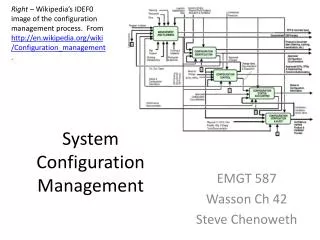
Right – Wikipedia’s IDEF0 image of the configuration management process. From http://en.wikipedia.org/wiki/Configuration_management. System Configuration Management EMGT 587 Wasson Ch 42 Steve Chenoweth
A few slides about this topic • It’s a system-wide accountability • Thus, a Systems Engineer thing to do • Fits in with system testing, acceptance testing, etc. • Also fits with white-box testing of interfaces, etc. • An architectural activity • Did we pick the right one? • Do the interfaces work? • The development config also is an issue! • So is documentation…
Baselines • First one – approved requirements • Thereafter – configuration control = control of every piece of info or product that goes into the system. • Also includes managing expectations. • And the project setup – like communications. • Endless list of “items”
Issues – p 492 • Configuration identification knowledge for most SEs typically comes from informal exposure via verbal discussions in meetings, on-the-job-training (OJT), and observation over many years. • Most engineers have little or no training in the principles of configuration management; most are selftaught through observation and knowledge of general CM standards. • By these means they feel able to proclaim themselves to be configuration experts.