
1 / 2

Enhancing High-Temperature Metallurgical Studies Using Advanced Microscopy Techniques

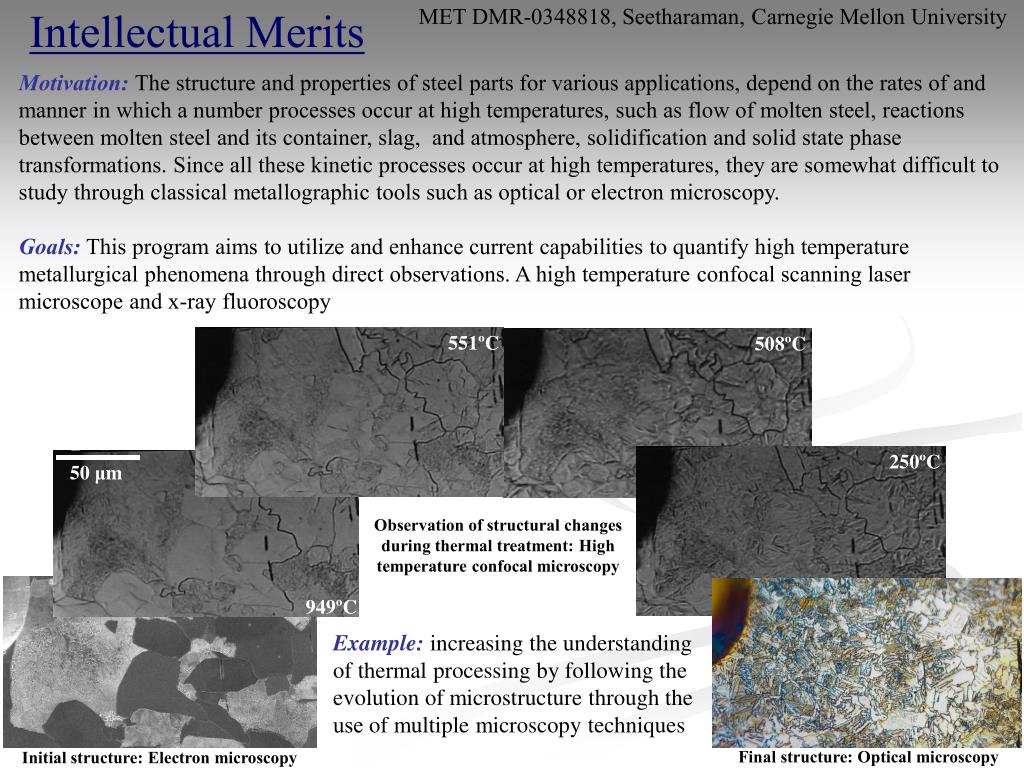
This project at Carnegie Mellon University focuses on understanding the structure and properties of steel at high temperatures, essential for various applications. Utilizing high-temperature confocal scanning laser microscopy and X-ray fluoroscopy, the program aims to quantify metallurgical phenomena through direct observation. The initiative also includes an educational web module showcasing solidification and phase transformation in Fe-based alloys. Outreach activities have engaged middle and high school students, promoting materials science through hands-on activities like metal casting and materials for rocket development.
zanthe
Télécharger la présentation

Enhancing High-Temperature Metallurgical Studies Using Advanced Microscopy Techniques

An Image/Link below is provided (as is) to download presentation Download Policy: Content on the Website is provided to you AS IS for your information and personal use and may not be sold / licensed / shared on other websites without getting consent from its author. Content is provided to you AS IS for your information and personal use only. Download presentation by click this link. While downloading, if for some reason you are not able to download a presentation, the publisher may have deleted the file from their server. During download, if you can't get a presentation, the file might be deleted by the publisher.

E N D

Presentation Transcript


  1. MET DMR-0348818, Seetharaman, Carnegie Mellon University Intellectual Merits 551ºC 508ºC 250ºC 50 μm 949ºC Motivation:The structure and properties of steel parts for various applications, depend on the rates of and manner in which a number processes occur at high temperatures, such as flow of molten steel, reactions between molten steel and its container, slag, and atmosphere, solidification and solid state phase transformations. Since all these kinetic processes occur at high temperatures, they are somewhat difficult to study through classical metallographic tools such as optical or electron microscopy. Goals: This program aims to utilize and enhance current capabilities to quantify high temperature metallurgical phenomena through direct observations. A high temperature confocal scanning laser microscope and x-ray fluoroscopy Observation of structural changes during thermal treatment: High temperature confocal microscopy Example:increasing the understanding of thermal processing by following the evolution of microstructure through the use of multiple microscopy techniques Final structure: Optical microscopy Initial structure: Electron microscopy

  2. Broader Impacts MET DMR-0348818, Seetharaman, Carnegie Mellon University Education:A web based module is being developed that shows CSLM movies of solidification and phase transformation phenomena for Fe-based alloys. The module will have the appearance shown below to the left. CSLM movies have been develop for a Fe-C alloys and examples are shown, in the figures to the right. The images show a-ferrite platelet precipitation from a g-matrix upon cooling. Outreach:A materials science module was developed and used for a two day SWE activity for female middle and high school students. The middle-school activities included: (i) casting miniature metal statues and characterizing cast structures, (ii) investigating temperature sensitive mechanical properties of polymers and (iii) introducing the phenomenon of superconductivity. The high school activities involved developing materials for a “rocket to be launched to space”. Approximately 50 students participated in each of the two age groups.

More Related