Classification
Classification is an essential practice in our lives, helping us label and group different entities. From taxonomy, which organizes living organisms into hierarchical categories, to genres in media like movies and music, classification provides order and clarity. For instance, the Linnaean system classifies humans as Homo sapiens, while movies are categorized into horror, action, and comedy. Understanding these categories allows us to comprehend relationships and similarities among organisms, and even navigate cultural differences in language.

Classification
E N D
Presentation Transcript
Classification • Asystem of labeling and grouping • Taxonomy is the practice of classifying
How do we classify in every day life? • Movies: Horror, action, comedy, drama • Music: Rap, rock, pop, country, electronica
Why classify? • Classification adds order and helps us make sense of the world • Classification also tells us how closely related organisms are
Linnaeus • Carolus Linnaeus proposed a system where organisms would be classified in hierarchical groups
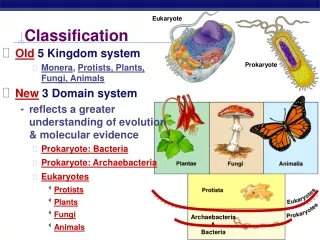
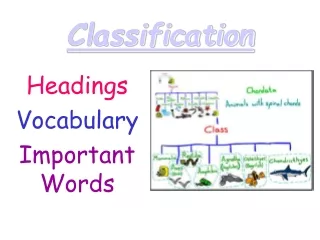
Domain • Kingdom • Phyla • Class • Order • Family • Genus • Species
Movie • Live Action • Horror • Supernatural horror • Found Footage • Paranormal Activity • Paranormal Activity 4 • Domain • Kingdom • Phyla • Class • Order • Family • Genus • Species
Example: Human • Domain: Eukaryotes • Kingdom: Animal • Phylum: Chordate (has a backbone) • Class: Mammal • Order: Primate • Family: Hominid • Genus: Homo • Species: Homo sapiens
Scientific names • Comprised of the genus and species • Human = Homo sapiens • Wolf = Canis lupus • Rose = Rosa rosa • First word capitalized, second word lowercase
Language barriers • In the United States the term “buzzard” applies only to vultures • In the United Kingdom, “Buzzard” can mean a hawk. • But Coragypsatratus refers to the American black vulture everywhere
Phylogenetic Trees/Cladograms • Visual representations of how organisms are related • Similar to family trees/pedigrees • Also called the“Tree of Life”
Nodes Branches
Nodes = Places where speciation occurred, common ancestors • Branches = Individual species
Groups next to each other are called sister groups • Humans and armadillos are sister groups in this diagram
1. Pick 10 aliens and identify them with the dichotomous key. Write this down next to the alien or on a separate paper (identify which aliens you are doing!) • 2. Create a dichotomous key for the second set of 10 aliens. Group them based on shared characteristics.
How to create the key • Find a characteristic that separates the aliens into two groups. Ex: Do the organisms have hair? • Set up a question: • 1) a. The organism has hair Go to 2 • b. The organism does not have hair Go to 3 • Continue until every species is sorted