Shakespeare
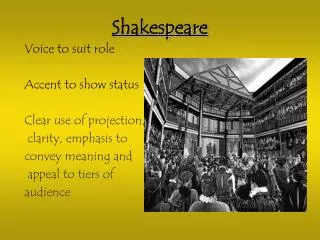
Shakespeare. Voice to suit role Accent to show status Clear use of projection, clarity, emphasis to convey meaning and appeal to tiers of audience. Voice to suit role. Actors in the Elizabethan era had to change their voice to suit the character.

Shakespeare
E N D
Presentation Transcript
Shakespeare Voice to suit role Accent to show status Clear use of projection, clarity, emphasis to convey meaning and appeal to tiers of audience
Voice to suit role • Actors in the Elizabethan era had to change their voice to suit the character. • This included a boy changing to female, no accent to accent and slang voice to clear voice to show class/status. • Boys whose voices had not broken and beards had not grown, were cast as female roles. • The strongest actor (William Kempe) played the main character in most of Shakespeare’s plays.
Voice to suit role • Important so audience knew their status or gender by use of voice. • Helped make the character more realistic with a voice that suited the character. • Audience responded to energy so no change in voice would have made it boring.
Accent to show status • This voice technique worked closely with costume to help show a character’s status. • Clear, precise language used by upper class • Harsh accent and careless use of language showed lower class. • Words more delicate and formal by high status • Words more rough and informal by low status
Clear use of projection, clarity, emphasis to convey meaning and appeal to tiers of audience • Voice was loud and projected so everyone could hear • Pronounciation and clarity of words important so audience could hear what was being said. • Words spoken with meaning and emotion could identify to audience a characters emotions/feeling at that point in the play.
Clear use of projection, clarity, emphasis to convey meaning and appeal to tiers of audience • When words spoken clearly and projected audience could follow the storyline. • Audience could hear important words in monologues when emphasised with meaning • The play can appeal to audience when spoken with meaning, clarity and projection. • Therefore adding realism and including the audience as the audience can believe the character.
Bibliography http://images.icnetwork.co.uk/upl/liverpoolecho/jul2009/8/6/image-2-for-outdoor-performance-of-shakespeare-s-the-merchant-of-venice-in-lydiate-gallery-214013015.jpg http://img2.allposters.com/images/MEPOD/10023472.jpg http://www.nlcphs.org/Academics/English/Pictures/shakespeare.jpg http://www.enotes.com/shakespeare-quotes http://www.wayneturney.20m.com/shakespearescompany.htm http://www.helium.com/items/536344-shakespeares-portrayal-of-women?page=2 http://www.william-shakespeare.info/william-shakespeare-quotes.htm