Exploring GIS: A Tool for Community Planning and Natural Resource Management
130 likes | 253 Vues
This overview explores Geographic Information Systems (GIS) and their benefits for communities and natural resource management. GIS enables planners, government agencies, and organizations to visualize, analyze, and manage spatial data effectively. From asset management to environmental planning, GIS enhances decision-making, improves efficiency, and fosters transparency. This resource highlights necessary steps for GIS implementation, available software options, and educational paths for professionals. Whether for urban planning, environmental monitoring, or public health, GIS is essential for data-driven solutions.


Exploring GIS: A Tool for Community Planning and Natural Resource Management
E N D
Presentation Transcript
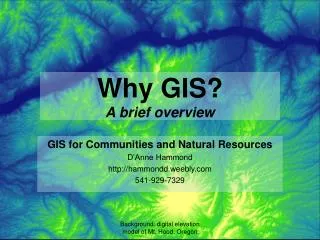
Why GIS?A brief overview GIS for Communities and Natural Resources D’Anne Hammond http://hammondd.weebly.com 541-929-7329 Background: digital elevation model of Mt. Hood, Oregon
WHO needs GIS? • City, county, state government • Planners, city councils, public works, assessors...more • Natural resource agencies • Health organizations • Scientists, businesses, utilities...more anyone involved in managing public assets or processes
WHAT is GIS? • Geographic Information System • For spatial data management and decision-making • Locates, overlays, analysis, planning, visualization • Where is the asset or problem? • What is affected by the asset or problem? • Who is affected by the asset or problem? All spatial information can be visualized, queried, managed, and manipulated using GIS
WHAT is GIS...ESRI* A geographic information system (GIS) lets us visualize, question, analyze, interpret, and understand data to reveal relationships, patterns, and trends. *Environmental Systems Research Institute Free GIS software is also available; GRASS, QGIS most common http://www.esri.com/what-is-gis
HOW to GIS? • Needs assessment • What do you want to get back out of your GIS? • Existing data (drawings, CAD, aerial imagery, other) • Data acquisition (planning, sources, time) • Decide who needs access to the data (data sharing) • Decide software/hardware (depends on implementation) • Learn how to use GIS - high learning curve • OR hire someone to teach it and use it • Convert / collect data • Implementation - create databases, etc.
GIS options • Own your system • most functional and convenient • Online applications • lower cost, host data off-site • Fully functional system (analyses) vs. • Simplified mapping, overlays, visualization • Asset management systems - many available • Pre-packaged • Piece it together • Integrate with field technology
GIS cost Depends on: • Existing data, conversion, acquisition • Extent of implementation • mapping vs. asset mgt. and analysis • System you choose to implement • software, hardware • Hiring vs. training • Available partnership opportunities • Available grants or other funding
GIS benefits • Cost reductions • Manual vs. GIS-based map creation • Reduced work-order entries (centralized) • Cost avoidance • Reduced cost issuing and tracking permits • Forecast infrastructure dev. (don’t overbuild) • Save time for property searches: centralized source for rights and encumbrances • Increased efficiency & productivity • Reduced man-hours hunting for maps
GIS benefits cont’d • Regulatory compliance • Improved coordination of projects • Link to utility billing and service monitoring Benefits lead to... • Increased transparency • Improved customer satisfaction and staff wellbeing • Better budget outcomes
Education & experience GIS, SNR, MPP • Graduate GIS certificate, OSU Geosciences • Advanced level ArcGIS • Remote sensing and raster data • Responsible GIS practice (ethics) • Philomath sign management • gps sign inventory: data dictionary and data collection, 750+ signs; FHWA, MUTCD, and GASB regs. • GIS map data connected to MSAccess (drawbacks) • OPRD grant, city and park maps
Education & experience • SNR certificate, used GIS for • imagery • watersheds • vegetation classification • regional ownership maps • GIS data enabled production of reports with land-use and other policy considerations • Master’s in Public Policy, rural focus • Policy research and analysis • Econometrics • Natural resources and community values • Poverty
GIS for Communities and Natural Resources • Needs assessment • Data collection • GIS implementation consult Connecting you with the right system and services to meet your needs