Understanding Accrual Accounting and Cash Flow Analysis
200 likes | 309 Vues
This document provides a comprehensive overview of accrual accounting principles, including the Revenue Recognition and Matching principles. It highlights the complexities between reported earnings and cash flows, emphasizing how analysts can interpret these differences to assess earnings quality. The preparation and interpretation of cash flow statements are discussed, along with real-world implications demonstrated through case studies on IBM and Tyco. The agenda covers accrual reversals, manipulation of net cash flow, and divergent definitions of free cash flow, offering practical insights for finance professionals.


Understanding Accrual Accounting and Cash Flow Analysis
E N D
Presentation Transcript
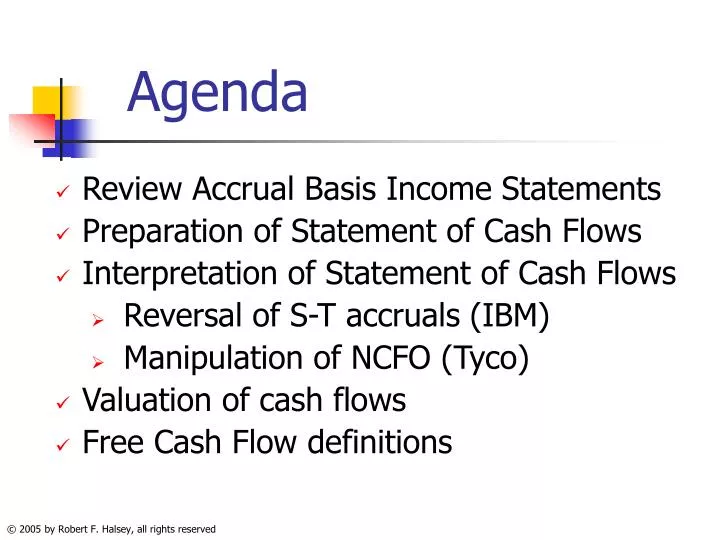
Agenda • Review Accrual Basis Income Statements • Preparation of Statement of Cash Flows • Interpretation of Statement of Cash Flows • Reversal of S-T accruals (IBM) • Manipulation of NCFO (Tyco) • Valuation of cash flows • Free Cash Flow definitions
Accrual accounting has two principal components: • The Revenue Recognition Principle, which states that revenue is recorded when it is “earned”, and • The Matching Principle, which states that expenses recognized when “incurred” • Neither the recognition of revenue nor that of expense necessarily involves the receipt or payment of cash. • Accrual basis earnings, therefore, do not convey much information about cash inflows to and outflows from the business.
Over the life of the firm, profit equals net cash flow. • In any one period,however, the two will not be equal because of accrual accounting. • Analysts have learned that the difference between reported earnings and cash flows may provide clues about the “quality of earnings” (i.e., whether the firm is managing its earnings) – Profit=cash flow +Accruals • Cash flow preparation exercise
Reversing nature of accruals • Companies can shift income from one period into another by the use of accruals. • Short-term accruals reverse over a 1-3 year period • Accruals for wages reverse in following month • Restructuring accruals re verse over several years • Evidence suggests that the market does not fully appreciate the reversing nature of accruals • IBM mini-case
Are these short-term swings in accruals priced? Source: Sloan (1996)
Source: R.F. Halsey “Stationary Components of Earnings and Stock Prices,” Advances in Quantitative Analysis of Finance and Accounting (2001)
0 0 1 1 Adj-R2 2 3 Adj-R2 Coefficient (T-statistic) Coefficient (T-statistic) -1.46 (-41.21) 24.56 (107.60) 2.02 (56.47) 6.16 (42.38) 13.65 % 2.90 (8.67) 1.38 (5.19) 10.55 % Pricet = 0 + 1Trendt + 2Cyclet + 3Irregulart + t PCYCt = 0 + 1Cyclet + t Source: R.F. Halsey “Stationary Components of Earnings and Stock Prices,” Advances in Quantitative Analysis of Finance and Accounting (2001)
Cash Flow Problem Areas • Securitization of A/R • Financing of customers as investing vs. operating activity • Trading securities • Exercise of ESOs Income tax payable xxx APIC Tax Benefit xxx • Leaning on A/P and reducing operating expenses • Tyco accounting for purchase of alarm contracts as CAPEX, yet cash inflows counted as operating • Transitory items (acquisitions, litigation, restructuring • Cash generated by discontinued operations • Tax paid (benefit) on nonoperating income (expense) • Capitalizing operating costs (WorldCom) • 4Q drop in NWC (quarterlies are not audited)
Differing Free Cash Flow Definitions • Benchmark definition: