SlideServe
Menu
Préférences
© SlideServe · v2026

The Cold War Part One

zeheb avatar
10 diapositives · 295 Views · Jul 25, 2014

The Cold War Part One. Ceallach Gibbons. People. USSR Leaders. Stalin. Khrushchev. Denounced Stalin’s legacy, Soviet Union entered a period of de-Stalinization Exposed Stalin’s tyranny and abuse of power Released many of Stalin’s political prisoners
The Cold War Part One - slide 1
01 / 10The Cold War Part One
1 / 17

Télécharger la présentation

The Cold War Part One
Une image / un lien ci-dessous est fourni (tel quel) pour télécharger la présentation

Politique de téléchargement : le contenu du site vous est fourni TEL QUEL pour votre information et votre usage personnel ; il ne peut être vendu, concédé sous licence ni partagé sur d’autres sites sans l’accord de son auteur.Le contenu vous est fourni TEL QUEL, pour votre information et votre usage personnel uniquement. Téléchargez la présentation en cliquant sur ce lien. Lors du téléchargement, si vous ne parvenez pas à télécharger une présentation, l’éditeur a peut-être supprimé le fichier de son serveur.Pendant le téléchargement, si vous ne parvenez pas à obtenir une présentation, le fichier a peut-être été supprimé par l’éditeur.

F I N

Plus de contenu associé

Transcription de la présentation
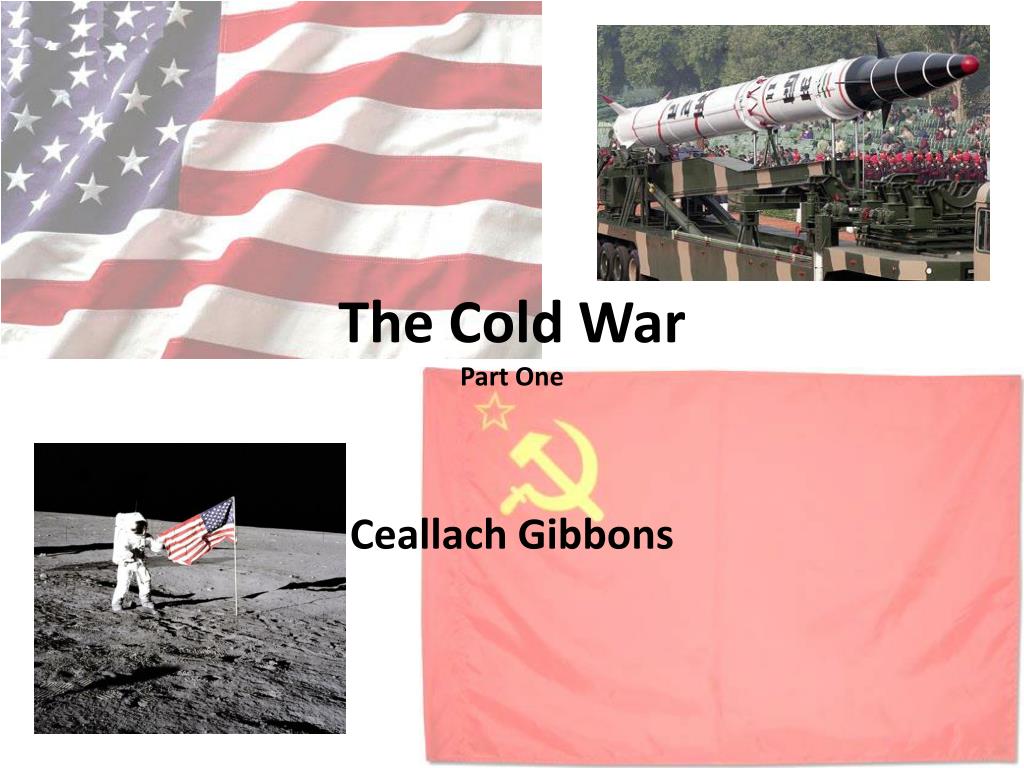
  1. The Cold WarPart One Ceallach Gibbons

  2. People

  3. USSR Leaders Stalin Khrushchev Denounced Stalin’s legacy, Soviet Union entered a period of de-Stalinization Exposed Stalin’s tyranny and abuse of power Released many of Stalin’s political prisoners USSR continued to try to catch up to the West economically Surpassed with the Sputnik space satellite in 1957 As aggressive as Stalin with foreign policy, stationed missiles in Cuba • Ruler of Soviet Union from 1922-1953 • Responsible for rapid industrialization and economic reform in Russia • 1930’s launched the “Great Terror,” to promote the Communist party, many people accused of treachery and terrorism, executed or imprisoned • After WWII Stalin installed communist governments in most of Eastern Europe, formed the “Iron Curtain” that began the Cold War

  4. USA Leaders Truman Roosevelt The Yalta conference is often cited as the beginning of the Cold War (2/4/1945-2/11) Roosevelt, Stalin and Winston Churchill (“The Big Three”), negotiated Soviet control of Easter Europe Churchill and Roosevelt were accused of being to easy with the Soviets, giving them too much land They declared that the Yalta conference just proved how powerful the Soviet Empire had become • Became president after Roosevelt’s death in d1945 • First American president to fight the Cold War • Focused on Western Europe instead of the Pacific, trying to avoid combat • Provided aid money for Turkey and Greece to keep them loyal to the United States (called the Truman Doctrine) • Issued the Marshall Plan to financially assist Western Europe

  5. Terms

  6. Post-War Europe NATO The Warsaw Pact The Soviet Union’s response to NATO A group of communist aligned countries, many forced to join Creation of the two programs led to proxy warfare and client states • The North Atlantic Treaty Organization • Countries aligned with the Untied States, opposed to Communism

  7. Exploding Technologies Mutually Assured Destruction American Military Industrial Complex Even in times of peace the governments of the world spent 100 billion dollars on military expenditures In President Eisenhower’s farewell speech, he warned the United States about the warning of military and industrial leaders whom it would behoove to engage in warfare His warnings were not heeded, Cold War broke out • Also called the ‘MAD’ theory • The idea that many people took comfort in, the idea that nuclear warfare would not break out, because it would mean the end of not only the country being bombed, but the end of mankind

  8. Events

  9. The Korean War • Communist North Korea invaded South Korea • Both had been colonies of Japan from 1910 to 1945 • China supported North Korea and the United States supported South Korea, millions of casualties • Increased the Chinese threat towards America • Helped Japan recover from WWII, was a manufacturing site for United States weapons • Hurt relationships between the United States and Europe, European countries did not support the United States’ heavy involvement in the war • Technology played a major role • NATO and Warsaw Pact formed as a result of the war

  10. The Cuban Missile Crisis • Fidel Castro, dictator in Cuba declared a “Six Point Program” reflecting communist philosophy • Established close relationship with the Soviet Union • As Castro carried out his plan, hundreds of thousands of Cubans fled, mostly to Miami • United States provided about 1500 of the refugees with weapons to then invade Cuba at the Bay of Pigs • Invaders defeated immediately • One year later (1962), the Soviet Union provided Cuba with nuclear tipped warheads, denied their existence • United States obtained photographic proof that such weapons existed, and threatened to start a nuclear war if they were not removed • USSR agreed to remove them, only if the United States promised not to invade Cuba again