Understanding Neuron Structure and Modeling: Hodgkin-Huxley and Fitzhugh-Nagumo Models
This project explores the structure of neurons, including cell bodies, dendrites, synapses, axons, and their roles in nerve impulse generation. It delves into the Hodgkin-Huxley model, which examines ionic currents and action potentials, represented by differential equations that describe ion conductance and voltage changes. We also discuss the Fitzhugh-Nagumo model, a simplified representation focusing on neuron bursting behavior under various stimulation levels. Both models are foundational to understanding neuronal behavior and dynamics.

Understanding Neuron Structure and Modeling: Hodgkin-Huxley and Fitzhugh-Nagumo Models
E N D
Presentation Transcript
Neuron Models Math 451 Final Project April 29, 2002 Randy Voland
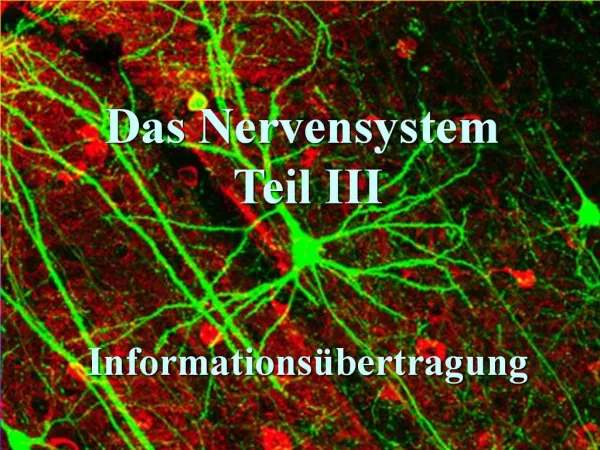
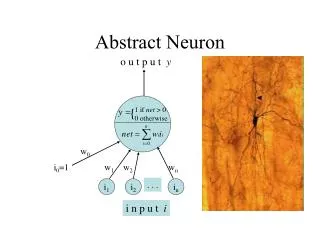
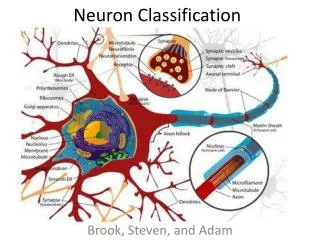
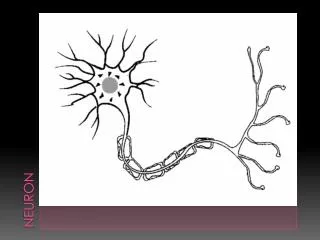
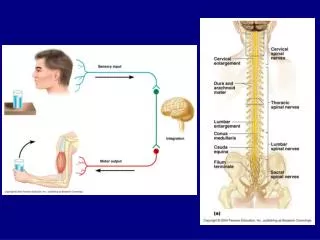
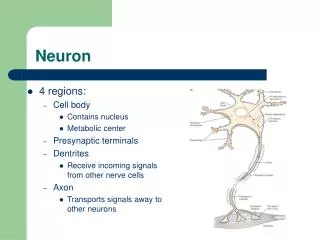
Neuron Structure • Cell Body • Dendrites • Synapses on Cell Body and Dendrites (Input) • Axon and Axon Branches (Output) Source: www.millennium.berkeley.edu/ ganglia/images/neuron.gif Source: www.gsu.edu/~wwwbgs/bgsa/ neuro/40x%20neuron.JPG
Nerve Impulse Generation Source: http://faculty.washington.edu/chudler/ap3.gif Source:www.biology.eku.edu/RITCHISO/ nervous_depolarization.gif Source:www.biology.eku.edu/RITCHISO/ nervous_repolarization.gif
Hodgkin-Huxley Neuron Model • Studied giant squid axons • Electrical stimulation • Measurements of ion currents • Mathematical model of action potential • Equivalent electric circuit of transmembrane processes • Four first order differential equations • Voltage rate of change • Rate of change of Na and K ion conductance
Hodgkin-Huxley Neuron Model dv/dt = (-1/c)*[gNa*m3*h*(v-vNa)+gK*n4*(v-vK)+gL*(v-vL)] dn/dt = αn(v)*(1-n)- βn(v)*n dm/dt = αm(v)*(1-m)- βm(v)*m dh/dt = αh(v)*(1-h)- βh(v)*h Potassium (K+) Ion Conductance Sodium (Na+) Ion Conductance
Hodgkin-Huxley Neuron Model c=1.0 gNa=120.0 gK=36.0 gL=0.3 vNa=-115.0 vK=12.0 vL=-10.5989 αn = 0.01*(v+10)/(exp((v+10)/10)-1) αm = 0.1*(v+25)/(exp((v+25)/10)-1) αh = 0.07*exp(v/20) βn = 0.125*exp(v/80) βm = 4*exp(v/18) βh = 1/(exp((v+30)/10)+1)
Variation in Ion ConductanceH-H Model vs. Nerve Source: http://courses.washington.edu/biophys/homework/hw6_files/image003.jpg
Action PotentialH-H Model vs. Nerve Source: http://courses.washington.edu/biophys/homework/hw6_files/image003.jpg
H-H Model in the v, m Phase Plane 4 0 2 3 1 3 2 1 3 0 4 0 4
Fitzhugh-Nagumo Neuron ModelModerate Stimulation – Limit Cycle
Summary • Hodgkin-Huxley Model • Models physical processes • Complex • Fitzhugh-Nagumo Model • Simpler/less physical • Models neuron bursting • Many other models in literature many based on Hodgkin-Huxley or Fitzhugh-Nagumo
Further Reading • Edelstein-Keshet, E. (1988) Mathematical Models in Biology, McGraw-Hill, 311-341. • Hodgkin, A.L. and Huxley, A.F. (1952) J. Physiol., 117, 500 – 544. • Fitzhugh, R. (1960) J. Gen. Physiol., 43, 867-896. • Fitzhugh, R. (1961) Biophys. J., 1, 445-466. • Feng, J. (2001) Neural Networks, 14, 955-975.