SlideServe
Menu
Préférences
© SlideServe · v2026

Three “Traditional Methods” (Before 1970)

zeke avatar
9 diapositives · 708 Views · Sep 04, 2012

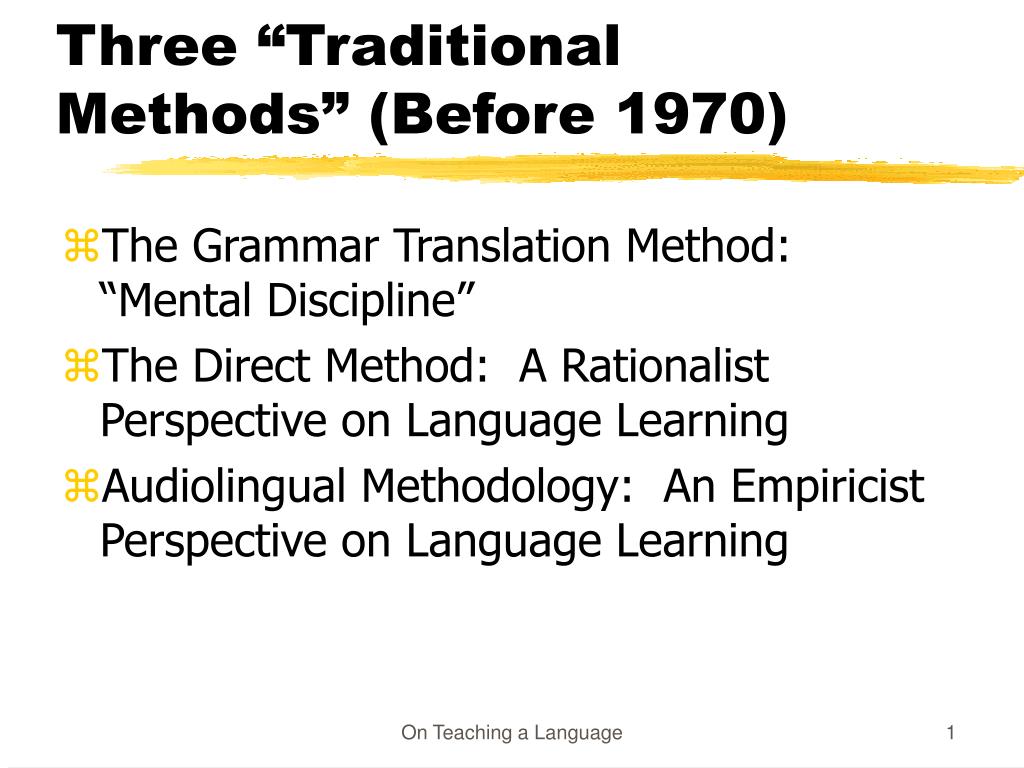
Three “Traditional Methods” (Before 1970). The Grammar Translation Method: “Mental Discipline” The Direct Method: A Rationalist Perspective on Language Learning Audiolingual Methodology: An Empiricist Perspective on Language Learning. Reactions to Audiolingualism: Two Mentalist Perspectives.
Three “Traditional Methods” (Before 1970) - slide 1
01 / 9Three “Traditional Methods” (Before 1970)
1 / 17

Télécharger la présentation

Three “Traditional Methods” (Before 1970)
Une image / un lien ci-dessous est fourni (tel quel) pour télécharger la présentation

Politique de téléchargement : le contenu du site vous est fourni TEL QUEL pour votre information et votre usage personnel ; il ne peut être vendu, concédé sous licence ni partagé sur d’autres sites sans l’accord de son auteur.Le contenu vous est fourni TEL QUEL, pour votre information et votre usage personnel uniquement. Téléchargez la présentation en cliquant sur ce lien. Lors du téléchargement, si vous ne parvenez pas à télécharger une présentation, l’éditeur a peut-être supprimé le fichier de son serveur.Pendant le téléchargement, si vous ne parvenez pas à obtenir une présentation, le fichier a peut-être été supprimé par l’éditeur.

F I N

Plus de contenu associé

Transcription de la présentation
  1. Three “Traditional Methods” (Before 1970) • The Grammar Translation Method: “Mental Discipline” • The Direct Method: A Rationalist Perspective on Language Learning • Audiolingual Methodology: An Empiricist Perspective on Language Learning On Teaching a Language

  2. Reactions to Audiolingualism: Two Mentalist Perspectives • The Cognitive Anti-Method (Newmark 1966, Newmark and Reibel 1968) • The Cognitive-Code Method (Chastain 1976) On Teaching a Language

  3. A Functional Approach: Communicative Language Teaching (Richard and Rogers 1986, others during the 80s)

  4. Modern Adaptations of the Direct Method • Total Physical Response (Asher 1972, Asher/Kusudo/de la Torre 1974) • The Natural Approach (Terrell 1977, 1986) On Teaching a Language

  5. Characteristics of the Natural Approach • Almost all classroom activities are devoted to communication. Grammar outside of class. • Importance of comprehensible input. • No error correction, just modeling. • “Acquisition” versus “Learning” • Importance of affective factors (friendly classroom atmosphere) • Speech emergence after silent period On Teaching a Language

  6. Humanistic Approaches to Language Teaching • Community Language Learning  • The Silent Way: Learning Through Self Reliance  • Suggestopedia: Tapping Subconscious Resources On Teaching a Language

  7. Summary of Chapter 3: • War of Methodologies versus Eclecticism • Proficiency as Organizing Principle • History of Methodologies On Teaching a Language

  8. Discussion and Activities On Teaching a Language

  9. Homework: • Read Chapter 4 • Answer Question 1 on p. 169 • Write down one thing that you learned and found particularly interesting, surprising and/or true. On Teaching a Language