Download
1 / 4
40 likes | 174 Vues
This study focuses on the numerical procedure used to analyze buoyant flow within cavity penetrations utilizing Code_Saturne V1.4.0. The model employs the K-epsilon standard wall functions, along with second-order convection and first-order upwind time schemes. Boundary conditions include Neumann conditions for velocity at inlets and Dirichlet conditions for axial and longitudinal velocities and pressure. Initial results are promising, with future work aimed at publishing findings and preparing an abstract for the UK National Heat Transfer Conference (UKHTC 2011).

E N D
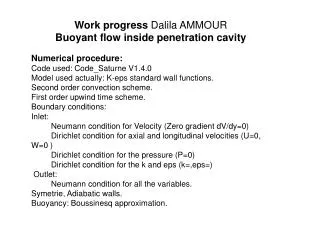
Work progress Dalila AMMOUR Buoyant flow inside penetration cavity Numerical procedure: Code used: Code_Saturne V1.4.0 Model used actually: K-eps standard wall functions. Second order convection scheme. First order upwind time scheme. Boundary conditions: Inlet: Neumann condition for Velocity (Zero gradient dV/dy=0) Dirichlet condition for axial and longitudinal velocities (U=0, W=0 ) Dirichlet condition for the pressure (P=0) Dirichlet condition for the k and eps (k=,eps=) Outlet: Neumann condition for all the variables. Symetrie, Adiabatic walls. Buoyancy: Boussinesq approximation.
Actual work and future plans: - Preparing tow papers to publish the previous work ... - Preparing an abstract for UKHTC 2011 UK National Heat transfer Conference ... - Start to implement AWF wall functions and test different cases ...