Download
1 / 16
160 likes | 275 Vues
This presentation by Alexander Rodack, under the mentorship of Dr. Olivier Guyon, details the innovative research funded by NASA Grant NNX13AC86G, focused on wavefront control for high-performance coronagraphy. It describes the fundamentals of coronagraphs, especially the Lyot and PIAAC types, and highlights the goal of developing a universal software package to facilitate experimental setups at various laboratories, including NASA facilities. Key findings and future steps aimed at enhancing imaging capabilities for exoplanets are also discussed, pivotal for upcoming NASA missions.

E N D
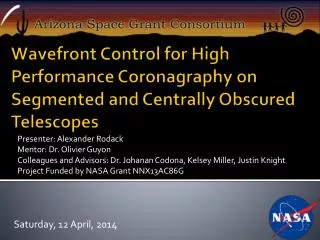
Presenter: Alexander Rodack Mentor: Dr. Olivier Guyon Colleagues and Advisors: Dr. Johanan Codona, Kelsey Miller, Justin Knight Project Funded by NASA Grant NNX13AC86G Wavefront Control for High Performance Coronagraphy on Segmented and Centrally Obscured Telescopes Saturday, 12 April, 2014
Outline • Introduction and Basic Terms • Research Goals/Methods • Current Progress • Next Steps • Future Application
What is Coronagraphy? • A coronagraph is a system to optically remove starlight from a science image • Originally used to study the corona of the Sun • Now being applied to directly imaging exoplanets The most simple of all coronagraphs, your thumb
Types of Coronagraphs • The Fundamental: The Lyot Coronagraph • The Lyot is the first coronagraph, to which optimizations were made to derive all the other types • The more Advanced: Phase Induced Amplitude Apodization Coronagraph (PIAAC) • The PIAAC utilizes aspheric optics to remap the pupil of the system • The advantage of this approach is that it is lossless, and can be tuned to have a low inner working angle (IWA)
Notes on Exoplanets • Exoplanets are planets that orbit stars other than the Sun • To find other habitable worlds, direct imaging must be made possible • This is currently difficult because an earth-like planet around a Sun-like star has a contrast ratio of 10-10
Science Goals for UA Testbed • High efficiency Wavefront Control • Necessary to meet requirements for cophasing mirror segments • LOWFS camera to drive wavefront control loop • Science camera acquires data at same speed as LOWFS camera to develop a ‘dictionary’ defining science Point Spread Function (PSF) response to wavefront aberrations • Use LOWFS to calibrate the Point-Spread Function (PSF) • Use measurements from WFS to estimate a long exposure PSF in the science camera image • Develop universal software package containing calibration algorithms
Universal Software Diagram • Development of universal software package will be applicable to other labs using similar hardware. • Includes other University labs and NASA labs • High Contrast Imaging Testbed (HCIT) at JPL • Allows for the Importing and exporting of ideas to and from other labs
Completed Work • Initial testbed setup and alignment • Mathematical model of Lyot coronagraph • Designed Lyot system for testbed implementation • Designed PIAAC system for testbed implementation • Devised computer system needed to run high speed cameras/deformable mirrors • Design of “laser safety box” (LSB) to contain supercontinuum source • class IV, 600 mW max output broadband source from ~400nm to ~2200nm, eye dangerous without attenuation
Next Steps • Implementation of • Supercontinuum source and LSB • PIAA optics • Deformable Mirrors (DM) • Replace testing camera with high speed CMOS camera • Integrate coronagraph optics • Focal Plane Mask (FPM) • Lyot Stop • Add high speed LOWFS camera • Perform tests and write algorithm
Next Steps CMOS CAMERA LOWFS CAMERA LYOT STOP FPM PIAA OPTICS DM 1 DM 2 SUPER CONTINUUM SOURCE
Application to Future NASA Missions • Will support near-term (WFIRST-AFTA) and longer term NASA missions to image and study exoplanets • Testbed is compatible with any pupil type by changing DMs. • Centrally-obscured • Segmented • Non-obscured • Matlab Models of other pupils are possible
Acknowledgements and Special Thanks • Dr. Olivier Guyon • Dr. Johanan Codona • Kelsey Miller • Justin Knight • Susan Brew • Leah Edwards
Any Questions? Thank You