Mathematics Grades 3-5 iEvolve
This presentation by Daniel J. Brahier from BGSU discusses the essential characteristics of the Common Core State Standards for Mathematics (CCSS-Math) for Grades 3-5. It emphasizes a framework of clearer and rigorous standards aligned with college and career expectations. Key themes explored include integrating higher-order skills, promoting effective problem-solving, and mathematical reasoning. Brahier highlights how to engage students in productive struggle, making mathematical concepts explicit, and fostering teacher collaboration. The importance of teaching students "how to fish" in mathematics is stressed.

Mathematics Grades 3-5 iEvolve
E N D
Presentation Transcript
Mathematics Grades 3-5iEvolve Daniel J. Brahier (brahier@bgsu.edu) BGSU/St. Rose School Wednesday, 22 May 2013
Characteristics of the CCSS-Math • Fewer, clearer, and higher • Aligned with college and career expectations • Internationally benchmarked • Include rigorous content and application of higher-order skills • Evidence- and/or research-based • Build upon strengths and lessons of current state standards • Promote collaboration among states for instruction, resources, assessment, and professional development
So, what IS “mathematics”? • Something that you “know” • Something that you “do” • All of the above! Mathematics is a VERB – something you “do”
NCTM Process Standards (1989) • Problem Solving • Reasoning and Proof • Communication • Connections • Representation
Standards for Mathematical Practice • Make sense of problems and persevere in solving them. • Reason abstractly and quantitatively. • Construct viable arguments and critique the reasoning of others. • Model with mathematics. • Use appropriate tools strategically. • Attend to precision. • Look for and make use of structure. • Look for and express regularity in repeated reasoning.
Student Responses Students rarely, if ever, answer a question “wrong.” Instead, they give a “correct” answer to a different question than we thought we were asking!
How do you “know” these? • 7 + 8 • 6 + 6 • 8 + 5
How do you “know” these? • 7 + 8 • 6 + 6 • 8 + 5
How do you visualize 3 x 5? Which of these is/are most accurate? Which reveal misconceptions?
How do you find the answer? 160 x 50
What do you know about each? • 14.7 ÷ 1.05 • 126.68 ÷ 0.97 • 164 x 0.76 Where does the decimal go: 27.49 x 8.31 = 2284419
Butterfly Multiplication Why does this work???
Scientific and Engineering Practices (NSTA, 2012) • Asking questions and defining problems • Developing and using models • Planning and carrying out investigations • Analyzing and interpreting data • Using mathematics and computational thinking • Constructing explanations and designing solutions • Engaging in argument from evidence • Obtaining, evaluating, and communicating information
Which is true about the Standards for Math Practice? • They are of equal importance. • They should be emphasized in an equitable manner at each grade level (similar time devoted to each). • They vary in importance at different grade levels.
Which is true about the Standards for Math Practice? • They are of equal importance. • They should be emphasized in an equitable manner at each grade level (similar time devoted to each). • They vary in importance at different grade levels.
An Old Joke • How do you kill a blue elephant? • With a blue elephant gun. • How do you kill a white elephant? • With a white elephant gun? • No, you first strangle the elephant until it turns blue and then use the blue elephant gun you already have!
Chinese Proverb Give me a fish and I eat for a day. Teach me to fish and I eat for a lifetime.
Practices Emphasis on the Mathematical Practices is equivalent to teaching our students “how to fish”!
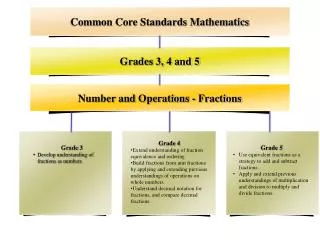
Domains for Grades 3-5 • Operations and Algebraic Thinking • Number and Operations in Base Ten • Number and Operations – Fractions • Measurement and Data • Geometry
Big Ideas (“Critical Areas”) in Grade 3 • Understanding of multiplication and division strategies up to 100 • Understanding of fractions, particularly unit fractions (numerator = 1) • Understanding of rectangular arrays and area • Describing/Analyzing two-dimensional shapes
Big Ideas in Grade 4 • Understanding/Fluency with multi-digit multiplication and division with quotients having multiple digits • Fractions – equivalence, add/subtract with same denominator, multiply by whole numbers • Analyzing/Classifying geometric shapes based on parallel sides, symmetry, etc.
Big Ideas in Grade 5 • Understanding/Fluency with adding/subtracting fractions and general idea of multiplying/dividing fractions • Decimals, including fluency in decimal operations up to hundredths • Developing an understanding of volume in three-dimensional shapes
Mathematics Grades 3-5iEvolve Daniel J. Brahier (brahier@bgsu.edu) BGSU/St. Rose School Wednesday, 22 May 2013