Evolutionary Journey of Primates and Human Ancestry
350 likes | 458 Vues
This overview explores the evolution of primates, highlighting key traits like mobile limbs, grasping hands, and advanced brain functions that shaped their development. From the earliest prosimians to modern humans (Homo sapiens), we chart the evolutionary tree, examining significant ancestors like Australopithecus, Homo habilis, and Homo erectus. The differences in anatomy, bipedalism, and the emergence of culture are discussed, along with the intriguing connection to Neanderthals and the Cro-Magnons. This journey reveals how environmental adaptations paved the way for human intelligence and cooperation.


Evolutionary Journey of Primates and Human Ancestry
E N D
Presentation Transcript
Kingdom Animal Phylum Chordate Class Mammal Order Primates Family Hominids Genus Homo Species Sapiens Classification Hierarchy
Evolution of Primates • The evolution of primates is characterized by trends towards: • mobile limbs • grasping hands (with opposable thumbs) • a flattened face • binocular vision • a large, complex brain (for learned behavior) • a reduced reproductive rate
Mobile Limbs • Most primates have flat nails as well as sensitive pads on the undersides of fingers and toes. • Many also have both an opposable big toe and thumb. • Mobile limbs and clawless opposable digits allow primates to freely grasp and release tree limbs.
Binocular Vision • Stereoscopic vision and resultant depth perception allows primates to make accurate judgments about distance and position of adjoining tree limbs.
Evolution of Primates • Prosimians were the first type of primate to diverge from the ancestral primate line. • Surviving anthropoids are classified into three superfamilies. • New World monkeys • Old World monkeys • Hominoids
Hominoid Evolution • Proconsul is believed ancestral to hominids.
Evolution of Hominids • Phylogenetic tree indicates humans are most closely related to African apes. • Last common ancestor appears to have lived about 5-7 million years ago (mya) • Genetic changes used as a molecular clock to measure relatedness of different groups.
Hominids • To be a hominid, a fossil must have an anatomy suitable for standing erect and walking on two feet. • Bipedalism • Human anatomy differs from that of an ape largely because humans are bipedal while apes are quadrupedal.
Australopithecines • It is possible that one of the australopithecines that evolved and diversified in Africa 4 mya is a direct ancestor of humans. • Southern Africa • Australopithecus africanus • Eastern Africa • Australopithecus afarensis (Lucy)
Lucy • A reconstruction of Lucy’s skeleton • Lucy is ~ 3.5-million-years-old • Australopithecusafarensis • adaptations in Lucy’s hip, leg and foot allowed a fully bipedal means of locomotion
Hominid Footprints • Preserved in volcanic ash in Tanzania • Discovered in 1978 • Proved hominids were bipedal walkers at least 3.5 million years ago • Most scientists think the footprints were made by A. afarensis, whose fossils are found nearby
Landscape with A. afarensis Re-creation of a Pliocene landscape showing members of A. Afarensis gathering and eating various fruits and seeds
Evolution of Early Homo • Homo habilis, dated between 2.0 an 1.9 mya, may be ancestral to modern humans. • Skulls suggest portions of the brain associated with speech were enlarged. • Ability to speak may have led to hunting cooperatively and the advent of culture.
Skull of Homo erectus • A reconstruction of the skull of Homo erectus • a widely distributed species • whose remains have been found in Africa, Europe, India, China, and Indonesia
Homo erectus • Homo erectus and like fossils are found in Africa, Asia, and Europe and are dated between 1.9 and 0.3 mya. • Larger brain and flatter face than Homo habilis. • Much taller than previous hominids. • Believed to have first appeared in Africa and then migrated into Asia and Europe. • First hominid to use fire.
Homo erectus Using Tools • Re-creation of a Pleistocene setting in which Homo erectus use fire & stone tools
Evolution of Modern Humans • Most researchers believe Homo sapiens evolved from Homo erectus. • Multiregional Continuity Hypothesis • Similar evolution occurred in many different places. • Out-of-Africa Hypothesis • H. sapiens evolved from H. erectus only in Africa, and thereafter migrated to Europe.
Neanderthals • Neanderthal (H. neanderthalensis) skeletons were first discovered in Germany’s Neander Valley. • Skeletons date back 200,000 years. • Massive brow ridges with protruding nose, jaws, and teeth. • Heavily muscled. • Culturally advanced. • Manufactured variety of tools.
Reconstructed Neanderthal skull • characterized by prominent heavy brow ridges and week chin
Burial Ceremony in a Cave Neanderthals lived in caves and had ritual burials, such as this depiction from Shanidar Cave, Iraq
Neanderthals (190,000 – 27,000 yrs ago) Flaked stones that fit in wood handles. Buried their dead with spices and bedding. Built sturdy huts. Made flutes! A flute formed from a femur & 4 remaining holes.
Cro-Magnons – Homo sapiens • Oldest fossils to be designated H. sapiens. • Modern humans who entered Asia and Europe from Africa 100,000 years ago. • Made advanced stone tools. • Accomplished hunters. • Hunted cooperatively. • First to have complex language?
Painting From a Cave in France • Cro-Magnons were very skilled cave painters • Painting of a horse from a cave in France
Homo Floresiensis(hobbits) - one meter high - lived in Flores 12,000 yrs ago - Upright posture - 380 cc cranial size (like a chimp)
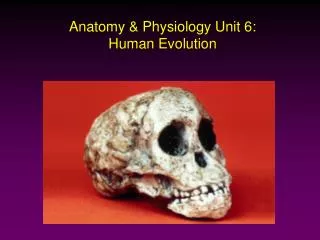
The shapes & sizes of hominid heads can be seen to evolve with time.
Australopithecus vs. Modern Australopithecus, 4-3 myrs ago Modern human Chimpanzee
Cranial Comparisons Homo Erectus Neanderthal Homo Sapiens
Cultural Evolution • With the appearance of Cro-Magnons, • human evolution has become almost entirely cultural rather than biological • Humans have spread throughout the world • by devising means to deal with a broad range of environmental conditions
Homo Sapiens100,000 yrs ago Art: Cave Paintings, Venuses Oldest paintings: Chauvet (32,000 yrs old) Peche Merle (15,000 yrs old) Lascaux (17,000 yrs old)