Understanding Merge Sort: A Divide and Conquer Approach to Sorting Arrays
This guide explores Merge Sort, a classic algorithm that utilizes the divide-and-conquer strategy to sort a sequence of numbers efficiently. By breaking down the sorting problem into smaller subproblems, Merge Sort recursively sorts these sections before combining them into a fully ordered sequence. The process entails dividing the array, recursively sorting each half, and then merging the sorted halves back together. This structured approach ensures optimal performance and clarity in sorting operations.

Understanding Merge Sort: A Divide and Conquer Approach to Sorting Arrays
E N D
Presentation Transcript
Divide and Conquer • Recursive in structure • Divide the problem into sub-problems that are similar to the original but smaller in size • Conquer the sub-problems by solving them recursively. If they are small enough, just solve them in a straightforward manner. • Combine the solutions to create a solution to the original problem Comp 122
An Example: Merge Sort Sorting Problem:Sort a sequence of n elements into non-decreasing order. • Divide: Divide the n-element sequence to be sorted into two subsequences of n/2 elements each • Conquer: Sort the two subsequences recursively using merge sort. • Combine: Merge the two sorted subsequences to produce the sorted answer. Comp 122
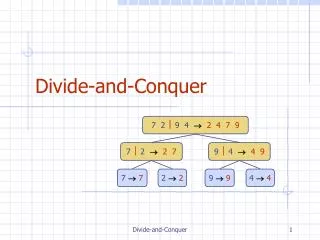
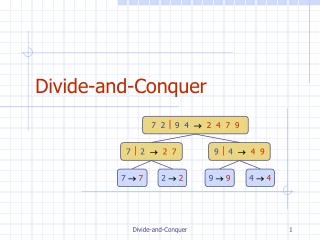
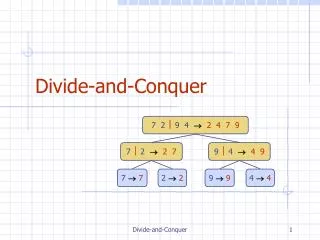
Merge Sort – Example 18 18 26 26 32 32 6 6 43 43 15 15 9 9 1 1 43 43 15 15 9 9 1 1 18 18 26 26 32 32 6 6 18 18 26 26 32 32 6 6 43 43 15 15 9 9 1 1 18 26 32 6 43 15 9 1 18 26 32 6 43 15 9 1 Original Sequence Sorted Sequence 1 6 9 15 18 26 32 43 6 32 26 26 32 6 18 18 9 15 1 43 1 9 15 43 26 32 15 18 6 43 18 26 6 32 15 43 1 9 1 9 15 26 32 1 18 26 32 6 43 15 9 1 18 15 43 9 6 26 9 1 32 6 18 43 6 43 18 26 32 1 15 9 Comp 122
Merge-Sort (A, p, r) INPUT: a sequence of n numbers stored in array A OUTPUT: an ordered sequence of n numbers • MergeSort (A, p, r) // sort A[p..r] by divide & conquer • ifp < r • thenq (p+r)/2 • MergeSort (A, p, q) • MergeSort (A, q+1, r) • Merge (A, p, q, r) // merges A[p..q] with A[q+1..r] Initial Call: MergeSort(A, 1, n) Comp 122
Procedure Merge Sentinels, to avoid having to check if either subarray is fully copied at each step. Input: Array containing sorted subarrays A[p..q] and A[q+1..r]. Output: Merged sorted subarray in A[p..r]. Merge(A, p, q, r) 1 n1 q – p + 1 2 n2 r –q • fori 1 ton1 • doL[i] A[p + i – 1] • forj 1 ton2 • doR[j] A[q + j] • L[n1+1] • R[n2+1] • i 1 • j 1 • fork p tor • doifL[i] R[j] • thenA[k] L[i] • i i + 1 • elseA[k] R[j] • j j + 1 Comp 122
Merge – Example A … 6 8 26 32 1 9 42 43 … 1 6 8 9 26 32 42 43 k k k k k k k k k L R 6 8 26 32 6 8 26 32 1 9 42 43 1 9 42 43 i i i i i j j j j j Comp 122
Correctness of Merge Loop Invariant for the for loop At the start of each iteration of the for loop: Subarray A[p..k – 1] contains the k –p smallest elements of L and R in sorted order. L[i] and R[j] are the smallest elements of L and R that have not been copied back into A. Merge(A, p, q, r) 1 n1 q – p + 1 2 n2 r –q • fori 1 ton1 • doL[i] A[p + i – 1] • forj 1 ton2 • doR[j] A[q + j] • L[n1+1] • R[n2+1] • i 1 • j 1 • fork p tor • doifL[i] R[j] • thenA[k] L[i] • i i + 1 • elseA[k] R[j] • j j + 1 • Initialization: • Before the first iteration: • A[p..k – 1] is empty. • i = j = 1. • L[1] and R[1] are the smallest • elements of L and R not copied to A. Comp 122
Correctness of Merge • Maintenance: • Case 1:L[i] R[j] • By LI, A contains p – k smallest elements of L and R in sorted order. • By LI, L[i] and R[j] are the smallest elements of L and R not yet copied into A. • Line 13 results in A containing p – k + 1 smallest elements (again in sorted order). • Incrementing i and k reestablishes the LI for the next iteration. • Similarly for L[i] > R[j]. Merge(A, p, q, r) 1 n1 q – p + 1 2 n2 r –q • fori 1 ton1 • doL[i] A[p + i – 1] • forj 1 ton2 • doR[j] A[q + j] • L[n1+1] • R[n2+1] • i 1 • j 1 • fork p tor • doifL[i] R[j] • thenA[k] L[i] • i i + 1 • elseA[k] R[j] • j j + 1 • Termination: • On termination, k = r + 1. • By LI, A contains r – p + 1 smallest • elements of L and R in sorted order. • L and R together contain r – p + 3 elements. • All but the two sentinels have been copied • back into A. Comp 122