Understanding Electrons and Their Location in Atoms
390 likes | 520 Vues
Learn about electron addresses, rules to remember, quantum numbers, orbital diagrams, Lewis dot structures, and Bohr models. Discover the principles governing electron behavior in atoms.


Understanding Electrons and Their Location in Atoms
E N D
Presentation Transcript
ELECTRONS AND THEIR LOCATION ELECTRON ADDRESSES
RULES TO REMEMBER • HEISENBERG UNCERTAINTY PRINCIPLE –Cannot know the exact location of an electron. Fundamentally impossible to know both the location and momentum/velocity of an electron at the same time. • The quantum mechanical model merely suggests the probability of the electron location. • No circular orbits – Sorry Bohr! • Instead: orbitals - the 3-dimensional region is which there is a high probability of finding an electron in an atom
Aufbau Principle • Electrons fill the lowest possible energy level. • Energy levels correspond to period number on the Periodic Table. • How many energy levels are there?
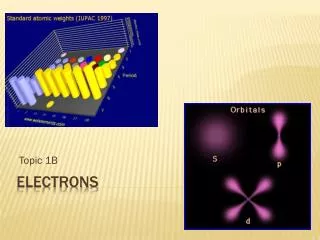
orbitals • Textbook definition: the 3-dimensional region is which there is a high probability of finding an electron in an atom • s on page 371 • p on page 372 • d on page 374
Pauli Exclusion Principle • No more than two (2) electrons in an orbital.
Hund’s Rule(s) • Orbitals of equal energy must fill singly before doubling. • (ex. all d’s must fill with 1 electron each before the second electron can fill in – like dealing cards) • All electrons in singly occupied orbitals have the same spin direction • Pairs of electrons in the same orbital have opposite spin.
QUANTUM NUMBERS • Describe the electron’s “address” • 1stQuantum is the principle quantum – describes the energy level, or period. • 2nd Quantum describes the shape of the orbitals. s,p,d,f • 3rd Quantum describes the orientation of the orbital • 4th Quantum describes the spin of the electron
What do you think the 5th energy level looks like? • The pattern stops – it looks like the 4th energy level • What about 6 & 7?
Quick Quiz • A. How many electrons can the p orbitals hold if filled? • B. How many kinds of orbitals are in the 4th energy level? • C. What are the orbitals of the 2nd energy level? • D. How many f orbitals are there? • E. How many electrons can any one orbital hold? • F. At most, how many electrons in the 2nd energy level?
Orbital Diagrams or Orbital Configurations • Use boxes and arrows to represent electrons in various energy levels. • Boxes must be labeled with regard to energy level and orbitals.
H orbital configuration 1s
H He orbital configuration 1s 1s
H He Li orbital configuration 1s 1s 2s 1s
H He Li Be orbital configuration 1s 1s 2s 1s 1s 2s
B C orbital configuration 1s 2s 2p 1s 2s 2p
N orbital configuration 1s 2s 2p
Practice • Draw orbital diagrams for elements # 4,6,9,15, and 26
Lewis Dot Structures • Element symbol represents atom nucleus and inner electrons. • Dots around the symbol represent valence (outermost energy level) electrons.
Lewis dot structure 1 Symbol
Lewis dot structure 1 2 Symbol
Lewis dot structure 1 2 3 Symbol
Lewis dot structure 1 2 3 Symbol 4
Lewis dot structure 1 2 3 5 Symbol 4
Lewis dot structure 1 2 5 3 Symbol 6 4
Lewis dot structure 1 2 5 3 Symbol 6 4 7
Lewis dot structure 1 2 3 5 Symbol 6 8 4 7
practice • Draw Lewis Dot structures for elements 1-11
Bohr Models • Use concentric circles to represent energy levels and the number of electrons in each.
Bohr model H 1-
Bohr model Li 2- 1-
Bohr model Ne 2- 8-
Bohr model S 2- 8- 6-
Bohr model K 2- 1- 8- 8-
Practice • Draw Bohr models for elements # 2, 3, 5, 9, and 16