Light and Electrons
This overview delves into the fundamental nature of light as both an electromagnetic wave and a particle. It explains key concepts such as wavelength (λ), frequency (ν), and their inverse relationship, with practical calculations. The text explores the visible spectrum, highlighting differences between long and short wavelengths. Additionally, it discusses Planck's theory of quantized energy and the photoelectric effect, where light can release electrons from metals, emphasizing the dual wave-particle behavior of light. Learn how light's properties impact technology and science.

Light and Electrons
E N D
Presentation Transcript
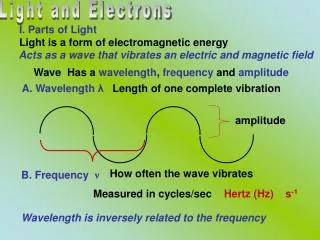
Light and Electrons I. Parts of Light Light is a form of electromagnetic energy Acts as a wave that vibrates an electric and magnetic field Wave Has a wavelength, frequency and amplitude A. Wavelength λ Length of one complete vibration amplitude How often the wave vibrates B. Frequency ν Measured in cycles/sec Hertz (Hz) s-1 Wavelength is inversely related to the frequency
c = λν c = speed of light (3 x 10⁸ m/s) λ = wavelength (m) ν = frequency in cycles/sec (s-1) What is the wavelength of light with a frequency of 1.23 x 10¹⁵ s-1? c = λν 3 x 10⁸ m/s = λ (1.23 x 10¹⁵ s-1) λ = 2.43 x 10⁻⁷ m About 243 nm Determine the frequency of red light with a wavelength of 623 nm. (623 nm = 623 x 10-9 m) c = λν 3 x 10⁸ m/s = (623 x 10-9 m) v v = 4.82 x 10¹⁴ s-1 Almost never changes!
C. Visible spectrum ROYGBIV Long wavelength Low frequency Short wavelength High frequency II. Light as a Particle quanta Light is released in small units A. Max Planck Energy of these units is related to frequency of light E = energy of quantum (J) v = frequency (s-1) h = Planck’s constant (6.63 x 10⁻³⁴ J-s) E = hv What is the energy of a photon with a wavelength of 236 nm? c = λν 3 x 10⁸ m/s = 236 x 10-9 m (v) v = 1.27 x 10¹⁵ sec-1 E = h v E = 6.63 x 10⁻³⁴ J-s ( 1.27 x 10¹⁵) E = 8.42 x 10⁻¹⁹ J
B. Photoelectric Effect When light of a particular wavelength hits a metal, electrons are released from the metal e- Different metals require different wavelengths Einstein believed that light acted as a particle photon The photon is the “packet of energy” described by Planck Photon gives all of its energy to the metal, (it disappears) which releases KE as the moving electron Energy of photon depends on the wavelength of light Ephoton = hv
C. Matter Waves It is assumed that light can act as a wave or a particle Can a particle of matter act as a wave? De Broglie Moving matter can be shown to have wave properties (Shows diffraction and interference patterns like a wave) Can determine the wavelength of the moving matter m = mass in grams v = velocity (m/s) λ = h mv