Download
1 / 20
200 likes | 337 Vues
This session explores the crucial aspects of new product development (NPD) with a focus on aligning NPD with business strategy and values. It reviews methodologies like functional maps and portfolio management, emphasizing the role of leadership exemplified by Jack Welch of GE in driving transformation. Key topics include competitive advantage, market dynamics, effective cross-functional teamwork, and the importance of technology and innovation. By adopting disciplined approaches and understanding metrics, companies can enhance their product development processes and foster sustainable growth.

E N D
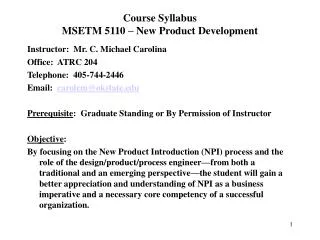
MSETM 5110 – New Product Development Purpose Connectivity Relevancy Application Science: “what is” Engineering: “creating what has never been”
MSETM 5110 – New Product DevelopmentRecap of Session II • NPI Alignment to Business Strategy and Values • The Concept of Functional Maps (Power in the Process) • Portfolio Management • GE’s Two-Decade Transformation: Jack Welch’s Leadership • The Continuum (Checklist) Exercise • Linkage to Business Strategy • Metrics and Tools • Cross-functional Teaming • Discipline and Commitment • Finding Solutions in the Face of Constraints/Challenges • Capital/Budgets • People Resources • Market Dynamics • Return On Investment • Economic Fluctuation
MSETM 5110 – New Product DevelopmentGE’s Two-Decade Transformation: Jack Welch’s Leadership Jack Welch’s View On: • Inheriting GE From Predecessor • Product Exit Strategy • Workout (Town Meetings, Departmental Meetings) • Globalization • People Development • Compensation practices • Managers as Teachers, Coaches, Mentors • Promotion Practices (Values vs. Results) • Capturing Employee Ideas • Customer Focus (Increasing the Customer’s Intellect and Helping the Customer Win) • E-Business (Spans Employees, Suppliers, Customers) • People with Energy and People Who Can Energize Others
MSETM 5110 – New Product DevelopmentWhy Do It? • Competitive Advantage/Staying Competitive • Short-term and Long-term Viability/Sustainability • Fund More Research • To Improve the Quality of Life • To Solve Technology-based Problems • New Platforms and Derivative Products • Improve Productivity and Efficiency • Protect Installed Base • Protect Customer’s Investment • Create Brand Loyalty • Vehicle for Strategic Partnership • Meet Stakeholders’ Expectations • Customers • Employees • Investors • Renewal and Transformation of the Organization
MSETM 5110 – New Product DevelopmentSuccessful Innovation Companies • Vision/Mission/Values • Alignment Around Value • People Systems Around Values • Organize for Success • Effective Integration and Communication • Clarity of Responsibility and Accountability • Focus on Results Thru Flawless Execution • Technology Platform Leader • Provide the Technological Foundation on Which Other Products Are Built • Interoperability • Encourage Other Companies to Develop and Build Complementary Innovations
MSETM 5110 – New Product DevelopmentSuccessful Innovation Companies (cont’d.) • Entrepreneurship/Intrapreneurship/”Venture Capitalist” • Focus on Continuous Improvement • Marketing/customer Requirements and Expectations • Research, Design, and Development • Manufacturing and Provisioning • Strategic Suppliers • Celebrate/Reward Success
MSETM 5110 – New Product DevelopmentDeveloping a Radical New Innovation Agenda • Continuous Reinvention (Transformation) • Avoiding “One-Vision” Wonders • Harnessing the Imagination of Every Employee • Developing New Financial Measures That Focus on Creating New Wealth • Creating Vibrant Internal Markets for Ideas, Capital, and Talent Reference: Gary Hamel, Leading the Revolution.
MSETM 5110 – New Product Development Applying Development Strategy and Resources to Stay Ahead of the Power Curve Preemptive Proactive Maximum Value
MSETM 5110 – New Product DevelopmentThe Continuum Exercise Checklist • Are strategy and goals clearly defined, understood, communicated, aligned, executed? • Is there a documented NPI process? • Are there the right metrics around the process? • Time to market/development cycle (e.g., from concept to customer or from design freeze to ready-to-order) • Status vs. project schedule • Recovery plan in place • Quality and reliability • Change activity • Target cost • Percent revenue from new products
MSETM 5110 – New Product DevelopmentThe Continuum Exercise (cont’d.) • Is there a mechanism to benchmark your organization vs. recognized best-in-class performance standards? • Is there a mechanism to capture learnings from each introduction that can be used to improve project after project? • Are the right tools available for project tracking? • Is there effective integration and communication across the functional teams (design, mfg., marketing)? • Are there the right skills on the team? • Is there the right commitment and passion for flawless execution?
MSETM 5110 – New Product DevelopmentCompetitive Benchmarking • The Search of Those Best Methods, Practices, and Processes That Will Lead to Superior Performance • Pioneered by Xerox and Other Corporations in the Early 80’s • Essentially Means Studying Major Competitors to Discover Their Strengths and Weaknesses • Typically Looks at Design, Marketing, Manufacturing, Customer Support, Distribution, etc. • Information Gathering Not Clandestine But Available in Public Financial Statements, Industry Analysis and Trade Journals • There Is A Defined Benchmarking Process
MSETM 5110 – New Product DevelopmentReasons for Benchmarking
MSETM 5110 – New Product DevelopmentReasons for Benchmarking (cont’d.)
MSETM 5110 – New Product DevelopmentKey Metrics for World Class Manufacturer • Manufacturing Cycle Time • D:P Ratios (Determines Build to Order or Build to Stock) • Setup Times • Material Availability • Material Velocity (Distance of Material Movement During Production) • Machine Up-time • Customer Service Time
MSETM 5110 – New Product DevelopmentMetrics • Simple • Actionable and Attainable • Drive the Right Behavior Assumptions: • There Is A Defined Process/System • There Is A Recognition That the Process/System Is Never the End • There Is Commitment to Continuous Improvement of the Process/System • Excellence Is Embraced As A Vision and Journey
MSETM 5110 – New Product Development Maintaining Schedule Control • Resource Commitment – Head Count, Fixed Costs, Expenses • Pricing For Major Customers and Major Accounts • Potential Slips in Major Milestone Dates (the executive sponsor wants early warning and recovery plans) • Plans for the Transition from Development Project to Operating Status • Thorough Reviews at Major Milestones or Every Three Months, Whichever Occurs Sooner • Review of Incentive Rewards That Have Company-wide Implications for Consistency and Equity • Cross-project Issues Such as Resource Optimization, Prioritization, and Balance Source: Wheelwright and Clark, pg. 212
MSETM 5110 – New Product Development Heavyweight Team Contract Book – Major Sections • Executive Summary • Business Plan and Purposes • Development Plan • Schedule • Materials • Resources • Product Design Plan • Quality Plan • Manufacturing Plan • Project Deliverables • Performance Measurement and Incentives Source: Wheelwright and Clark, Exhibit 8-3
MSETM 5110 – New Product Development Responsibilities of Heavyweight Core Team Members Functional Hat Accountabilities: • Ensuring Functional Expertise on the Project • Representing the Functional Perspective on the Project • Ensuring That Subobjectives Are Met That Depend on Their Function • Ensuring That Functional Issues Impacting the Team Are Raised Proactively Within the Team
MSETM 5110 – New Product Development Responsibilities of Heavyweight Core Team Members (cont’d.) Team Hat Accountabilities: • Sharing Responsibility for Team Results • Reconstituting Tasks and Content • Establishing Reporting and Other Organizational Relationships • Participating in Monitoring and Improving Team Performance • Sharing Responsibility for Ensuring Effective Team Processes • Examining Issues From an Executive Point of View (answering the question, “Is this the appropriate business response for the company?”) • Understanding, Recognizing, and Responsibly Challenging the Boundaries of the Project and Team Process Source: Wheelwright and Clark, Exhibit 8-5
MSETM 5110 – New Product DevelopmentAssignment 1 Case Study 1 (HBR 9697052) – Living on Internet Time: Product Development at Netscape, Yahoo!™, NetDynamics, and Microsoft® In approximately 400 words, (a) compare and contrast the development philosophy, process and culture at Netscape, Yahoo!, NetDynamics, and Microsoft; and (b) rank the companies (1 through 4) in terms of year-over-year growth (e.g. market share, revenue, profitability, dividends, etc.) since the early and mid-90’s—the time frame in the case study. DUE DATE: Friday, July 12, 2002