Exploring Piety in Plato's Euthyphro: A Philosophical Inquiry
In Plato's "Euthyphro," Socrates engages Euthyphro in a profound examination of piety. Set near the Athenian courts, this dialogue raises critical questions about the nature of piety: Is it pious because it is loved by the gods, or is it loved by the gods because it is pious? The text delves into the definition of piety, illustrating it as a service to the gods, a knowledge of rituals, and actions that please them. Through this, Plato explores the relationship between morality, divinity, and human interactions, prompting readers to ponder the essence of piety.

Exploring Piety in Plato's Euthyphro: A Philosophical Inquiry
E N D
Presentation Transcript
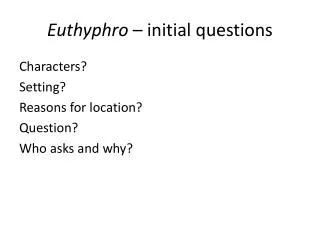
Euthyphro – initial questions Characters? Setting? Reasons for location? Question? Who asks and why?
What is piety? • “…the pious is to do what I am doing now” (5e) • “what is dear to the gods is pious…” (7a) • “the pious is what all the gods love…” (9e) -Is it (x) pious because it is loved by the gods, or -is it (x) loved by the gods because it is pious?
Piety is… • “the godly and the pious is the part of the just that is concerned with the care of the gods…” (12e) • Piety is “a kind of service of the gods” (13d) • “I say that if a man knows how to say and do what is pleasing to the gods at prayer and sacrifice, those are pious actions…” (14b) • Piety is “a knowledge of how to give to, and beg from, the gods.” (14d) • Piety is “of all things most dear” to the gods. (15b)