Exploring Direct and Inverse Variation: Ramp Height and Length Investigation
This investigation examines the concepts of direct and inverse variation through practical examples involving ramp height and length in relation to time. It explores the mathematical representations of direct variation (y = kx) and inverse variation (y = k/x), as well as their graphical interpretations. The investigation also includes solving problems to find constants of variation and applying these concepts to real-life scenarios, such as electrical current and voltage relationships. Discover the significance of the constant "k" in these relationships.

Exploring Direct and Inverse Variation: Ramp Height and Length Investigation
E N D
Presentation Transcript
Direct and Inverse Variation Investigation #1 Ramp height and length vs time
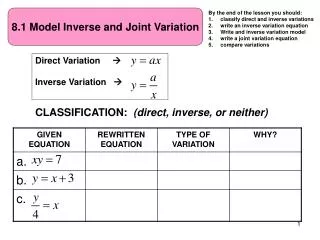
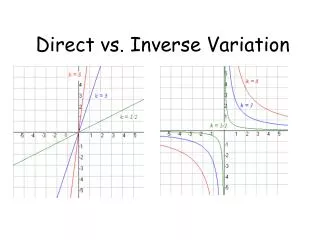
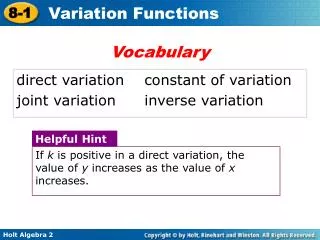
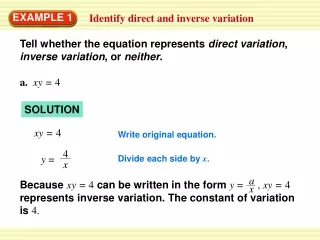
Direct vs Indirect • “yvaries directly as x" means… y = kx What does that graph look like? • “yvaries inversely as x" means… y = k/x What does that graph look like? What is k? the constant at which the graph “changes”
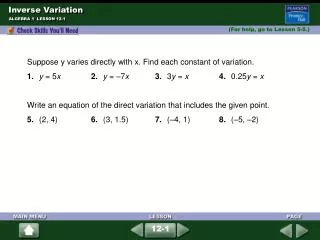
1.) y varies directly with x. If y = -4 when x = 2, find y when x = -6. • 2.) y varies inversely with x. If y = 40 when x = 16, find x when y = -5.
Direct, Indirect, or Neither? • g = -7p • v = f / -3 • d = 9 / r
What is the constant of variation (k)? • u = 5m • z = -0.3/r • y = (1/3) f
Real life… (from worksheet) • 26) The electric current I, is amperes, in a circuit varies directly as the voltage V. When 12 volts are applied, the current is 4 amperes. What is the current when 18 volts are applied?